ADR and Dangerous Goods.

Updated: 2 days ago
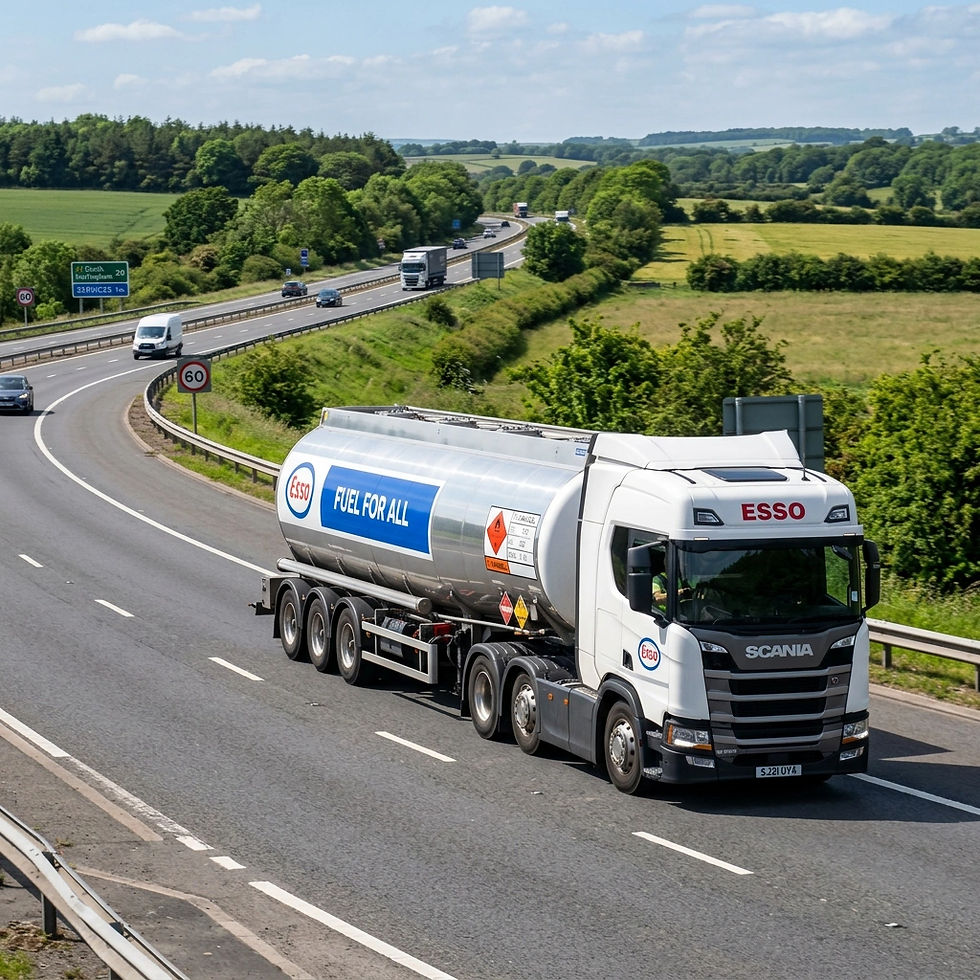
A practical introduction for new HGV drivers.
Dangerous goods are not only carried in tankers. You can also encounter them in drums, cylinders, boxes, IBCs and mixed pallet loads.
This guide explains what to recognise, what to check and when to ask for help. It is an awareness guide, not a substitute for ADR training, certification or instructions for a particular load.
What is ADR?
ADR is the agreement governing the international carriage of dangerous goods by road. Ireland also applies ADR requirements to domestic transport through Irish legislation.
It covers much more than driving: classification, packaging, documents, training, vehicle equipment, loading and unloading all form part of the system. The requirements depend on the goods, quantity, packaging and method of carriage.
Do I need an ADR certificate?
Your HGV licence and Driver CPC do not replace an ADR driver training certificate.
Where certification is required, it must cover the classes of dangerous goods and the type of carriage involved. Tank work can require additional training, while explosives and radioactive materials have specialist requirements.
Some exemptions remove the requirement for an ADR driver certificate, but appropriate dangerous-goods training can still be necessary.
Before accepting the job, establish whether your qualifications cover it. Your transport manager or Dangerous Goods Safety Adviser, usually called the DGSA, should resolve any uncertainty.
Labels, orange plates and placards
These markings serve different purposes:
Package labels identify the hazard associated with the goods.
Orange plates identify transport units carrying dangerous goods where required.
Placards are larger hazard diamonds used on containers, tanks and certain vehicles.
Numbered orange plates, where required, provide hazard and UN identification information.
The correct arrangement depends on the load and how it is carried. A curtainsider carrying packages does not automatically need the same markings as a tanker.
Check the required markings before departure. Do not assume that unloading means every marking can immediately be covered: empty, uncleaned tanks and packaging can still be subject to ADR.
Paperwork before departure
For a journey subject to the full requirements, check that the necessary documents are available, including:
The dangerous-goods transport document.
The official ADR Instructions in Writing.
Your valid ADR driver certificate.
Photo identification for each crew member.
A vehicle ADR approval certificate where the vehicle category requires one.
Read the load information before setting off. Raise missing information, conflicting details or unclear instructions before moving the vehicle.
The Instructions in Writing are the standard emergency instructions. Where required, they must be readily available in the cab, in a language each crew member can read and understand.
Familiarise yourself with the hazards and actions relevant to the load before the journey.
The ADR equipment box
You may find an ADR equipment box mounted externally on the side of the truck or trailer. Other vehicles store equipment in different compartments.
Ask to be shown where everything is kept. A box marked “ADR” does not prove that the correct equipment is inside.
Check the contents against the requirements for the actual load. Depending on the hazards, equipment includes warning signs, suitable wheel chocks, eye-rinsing liquid, protective gloves, eye protection, warning vests and suitable portable lamps. Certain loads require escape masks or a shovel, drain seal and collecting container.
Equipment requirements vary: not every item applies to every load. Check condition, accessibility and any expiry dates.
Fire extinguishers
For transport units subject to the full ADR extinguisher requirements, the usual minimum capacities are:
Maximum permissible mass of the transport unit | Minimum total capacity* |
Up to 3.5 tonnes | 4 kg |
Over 3.5 tonnes, up to 7.5 tonnes | 8 kg |
Over 7.5 tonnes | 12 kg |
Dry powder, or equivalent capacity using another suitable extinguishing agent.
At least two extinguishers are required under these full provisions, including one suitable for a cab or engine fire with at least 2 kg capacity. Above 3.5 tonnes, at least one extinguisher must have a capacity of 6 kg or more.
For example, a single 12 kg extinguisher does not satisfy the full requirement simply because its capacity totals 12 kg.
Different provisions apply to certain loads and exemptions. Under ADR 1.1.3.6, the minimum is generally one suitable 2 kg extinguisher.
Dashboard switches and emergency controls
An ADR-equipped vehicle may have battery isolation or emergency shutdown controls. Tanker equipment may also have separate controls for pumps, valves or transfer systems.
There is no universal dashboard layout. A red switch, protective cover or unfamiliar symbol is not enough to identify what a control does.
Before using the vehicle, ask for a demonstration covering:
What each relevant control operates.
When it should be used.
Which systems it affects.
The correct shutdown and restart procedure.
Follow the manufacturer’s instructions and your employer’s vehicle-specific training. Never experiment with an unfamiliar switch while driving or during loading or unloading.
Loading and unloading
Check for visible leaks, damaged packaging and insecure goods before departure. Report defects and have them resolved.
Follow the loading plan and any segregation requirements. Dangerous goods may have restrictions on being loaded together or alongside food and animal feed.
Only operate pumps, hoses, valves or transfer equipment when trained and authorised. Follow site instructions, including ignition-source restrictions and any required earthing or bonding procedures.
Do not open dangerous-goods packages as part of an informal inspection.
Does a small load mean ADR does not apply?
Not necessarily.
The small-load exemption under ADR 1.1.3.6 applies to qualifying carriage in packages. It is not a general exemption for tank or bulk transport.
You may hear it called the “1,000-point rule”. That does not mean every load below 1,000 kg or 1,000 litres qualifies. Transport categories, quantities and mixed-load calculations matter.
Limited quantities are a separate arrangement involving specified packaging and quantity limits. The two systems are not interchangeable.
Ask the transport office or DGSA to establish which exemption applies and which duties remain. Do not decide from the number of pallets or the appearance of the load.
Tunnels, parking and security
Check the planned route before departure, including any dangerous-goods tunnel restrictions. A route suitable for an ordinary HGV may not be suitable for your load.
Confirm approved stopping and parking arrangements with your employer. Some loads have additional supervision or security requirements.
Follow the company’s security procedures, secure the vehicle and report suspicious activity. Avoid publicly sharing sensitive load details or planned stopping locations.
If something goes wrong
Follow your ADR training and the official Instructions in Writing.
Where safe, stop, secure the vehicle, shut down as instructed and avoid ignition sources. Move away from the danger and keep others away.
Call 112 or 999 in Ireland. Explain that dangerous goods are involved and provide your location and load information when safe to do so.
Do not touch spilled substances, walk through a spill or breathe fumes. Do not attempt to fight a fire involving the load. A small cab, engine or tyre fire should only be tackled when safe and within your training.
An escape mask is for escape; it does not make it safe to enter a contaminated area or attempt a rescue.
Before you turn the key
Make sure you can answer these questions:
Am I trained and qualified for this job?
Do I understand what I am carrying?
Are the documents and markings correct?
Is the required equipment present and usable?
Do I understand the vehicle’s relevant controls?
Is the load secure, with no unresolved damage or leakage?
Have the route and stopping arrangements been checked?
Do I know what to do and whom to contact if something goes wrong?
If something is missing or unclear, get it resolved before departure.
Guidance checked October 2026 against ADR 2025 and official supporting guidance. Irish rules and any applicable national arrangements must be checked for the specific operation.
NOTE-
Looking ahead to ADR 2027
ADR 2027 is scheduled to take effect on 1 January 2027, with a general transition period allowing continued use of ADR 2025 until 30 June 2027. The changes cover battery transport, including lithium and sodium-ion batteries, as well as certain documentation, marking, training and emergency-instruction requirements.
Some provisions have longer transition periods, so the deadlines will depend on the change involved. For drivers, the practical message is simple: check with your employer or Dangerous Goods Safety Adviser (DGSA) whether your loads, paperwork, equipment or training will be affected.
ADR 2025 remains the current edition for this guide as of October 2026. Read the ADR 2027 changes overview and consult the official UNECE amendments for the detailed requirements.



Comments