Air Suspension Controls.

Updated: 2 days ago
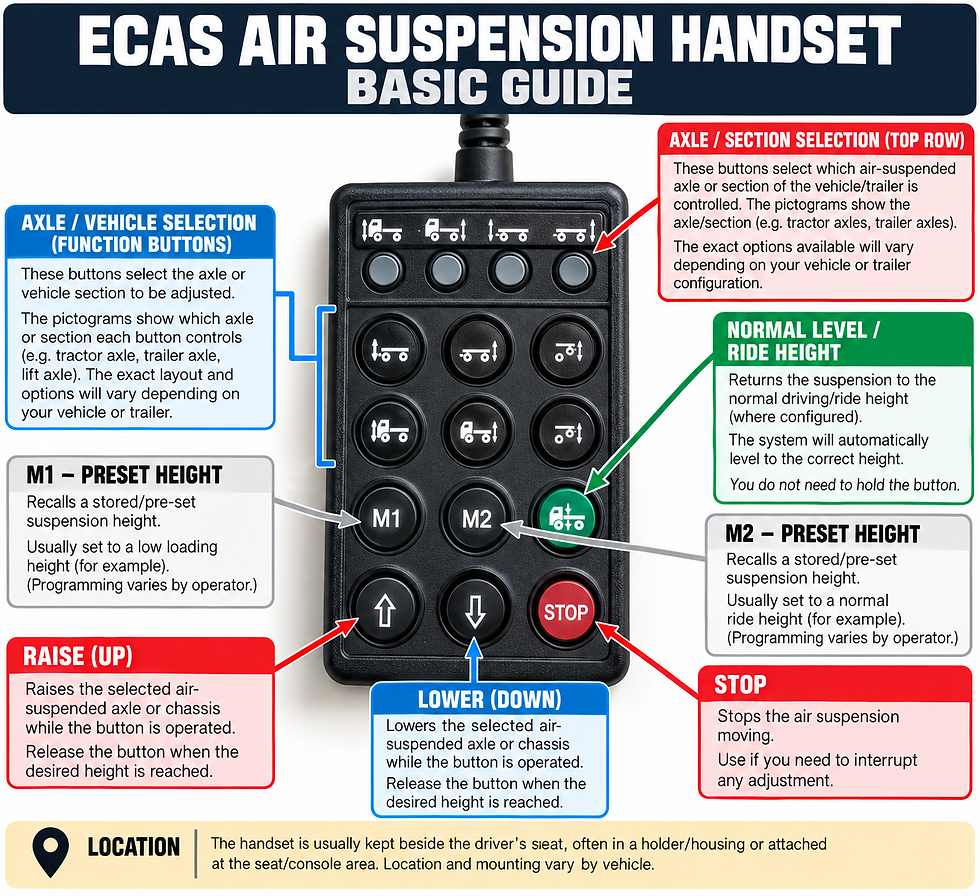
The Handheld Box & Dash Buttons.
Important note: Air suspension controls differ from vehicle to vehicle. If you aren't sure-ASK!
Air suspension controls are one of those things that become completely automatic once you've been driving for a while.
You press a button, the lorry goes up. Press another, it comes down. Job done.
But if you're sitting in an unfamiliar lorry for the first time looking at a box covered in pictures of axles, arrows and mysterious M1/M2 buttons, it's not necessarily obvious what any of it does.
So here's the basic version.
Important: controls, symbols and available functions vary between manufacturers, vehicles and suspension specifications. This is a general familiarisation guide, using a common WABCO ECAS-type handset as the example. Always familiarise yourself with the particular vehicle you're driving.
First: what are we actually controlling?
Many HGVs use air suspension rather than conventional steel springs on some or all axles.
Air bellows support the vehicle, and the suspension system automatically maintains a predetermined normal ride height as load changes.
The driver can also alter the suspension height for particular jobs — for example:
Coupling or uncoupling.
Matching the vehicle or trailer height to a loading bay.
Loading and unloading.
Changing body height where the vehicle's operation requires it.
Certain manoeuvring situations, depending on the vehicle.
The important bit is that normal driving is done at the vehicle's normal ride height unless the manufacturer specifically provides another operating mode.
The handheld air-suspension control
You may hear this called the air box, suspension handset, ECAS remote, air remote or simply “the box beside the seat.”
On many lorries you'll find it beside the driver's seat, often attached to the seat/seat frame or console in its own holder. Some installations use a magnetic mounting arrangement.
If you've just got into an unfamiliar air-suspended lorry and can't find it, have a look down around the side of the driver's seat before deciding it doesn't have one.
The exact handset varies, but the one pictured above is a common WABCO ECAS-style remote.
↑ UP
Pretty self-explanatory.
Press and hold ↑ to raise the selected air suspension.
Release it when you've reached the height you need.
↓ DOWN
The opposite.
Press and hold ↓ to lower the selected air suspension.
Again, release it when you've reached the required height.
WABCO confirms that its ECAS remote alters chassis height using the up/down controls and stops the height change when the control is released.
🟢 Normal ride height
This is an important one.
The green normal-level button tells the ECAS system:
“Put yourself back where you're supposed to be for normal driving.”
Press it and the system returns the suspension to its pre-calibrated normal ride height automatically.
So if you've dropped or raised the suspension while loading, coupling or doing something else, don't just eyeball it afterwards and think:
Yeah. That looks about right.
Use the proper normal-level function.
M1 and M2
These are memory positions.
They allow particular suspension heights to be stored and recalled.
For example, a vehicle might have a useful loading or operating height stored so that instead of manually going:
little bit up... little bit more... WHOA... tiny bit down...
you can recall the stored position.
But here's the important bit:
M1 and M2 do NOT have one universal meaning.
What is stored in them depends on the vehicle and how the system has been programmed.
On the WABCO system, pressing M1 or M2 recalls the corresponding stored height. WABCO documentation also describes storing a height by using STOP together with the relevant memory button.
New driver rule: don't assume you know what somebody else's M1 and M2 are programmed to do.
🛑 STOP
STOP interrupts a suspension adjustment commanded through the handset.
If you've pressed a memory position or another adjustment and need the movement to stop:
press STOP.
WABCO specifically describes the STOP button as interrupting height-control functions.
What are all the little pictures of axles?
This is where the handset can initially look much more complicated than it actually is.
Depending on the vehicle specification, ECAS can control different axles or suspension sections.
The little vehicle/axle diagrams are used to select the part of the suspension you want to control.
Not every vehicle will have every possible function, and handset layouts vary.
Look at the picture before pressing the button.
If you're not sure what a particular axle symbol controls on that vehicle, find out during your vehicle familiarisation rather than experimenting with a loaded lorry.
The air-suspension buttons on the dashboard
The same basic suspension controls may also appear on the dashboard.
You'll commonly see buttons showing a lorry/chassis with an up or down arrow.
These allow the appropriate air-suspended section of the vehicle to be raised or lowered, subject to how that particular vehicle has been configured.
One situation that catches new drivers is this:
You've lowered the suspension.
You finish what you're doing.
Start preparing to drive away and the dashboard tells you something along the lines of:
SELECT RIDE HEIGHT
Don't panic.
On vehicles configured this way, selecting the normal/drive-height function tells the electronic suspension system to return itself to its calibrated running position.
On some trucks this is achieved through the dash suspension control; on others through a normal-level control or menu. The exact button sequence is manufacturer- and model-specific.
Once selected, let the system do its job rather than trying to manually guess the correct ride height.
The lift axle button
If your lorry has a lift axle, you'll normally also have a control for it.
A lift axle exists partly because you don't necessarily need every axle on the ground when the vehicle is lightly loaded or empty.
Depending on the vehicle, axle configuration and programming, the system may automatically raise or lower a lift axle according to axle load and other operating conditions.
As weight increases, the axle may automatically lower because it's needed to carry the load.
That isn't the lorry ignoring you.
It knows it's heavy.
Can I lift it manually?
Where the vehicle permits it, yes — but there are conditions and limits built into these systems.
Manually lifting an appropriate lift/tag axle at low speed can improve manoeuvrability by effectively shortening the wheelbase and reducing tyre scrub.
That's particularly handy during tight turns.
Volvo, for example, explicitly describes axle-lift systems as improving turning radius, while also making clear that raising is dependent on axle-load limits and that the axle lowers again when the load requires it.
So:
Lift axle up = potentially tighter turning circle and less tyre scrub.
But:
The button does not give you permission to overload the remaining axles.
The vehicle's system may refuse the command or lower the axle automatically when load conditions require it.
And different axle arrangements — tag, pusher, tandem axle lift etc. — don't all behave identically.
⚠️ A VERY IMPORTANT WORD ABOUT WEIGHT
Lifting an axle changes where the vehicle's weight is being carried.
That means it changes individual axle loads.
So while the vehicle may allow an axle to be lifted under suitable conditions, don't think of a lift axle purely as a manoeuvring gadget.
Axle-weight limits still apply.
The suspension management system is clever.
It isn't a magic exemption from physics or road traffic law.
When would I use the air suspension?
Common examples include:
Coupling and uncoupling: altering tractor suspension height can help correctly position the fifth wheel relative to the trailer. It does not replace correct coupling procedure.
Loading bays: adjusting suspension can help match deck height to the bay where the vehicle and site arrangements allow it.
Loading/unloading: certain bodies and operations require a particular working height.
Demountable/body systems: suspension adjustment may form part of the operating procedure.
Lift axle/manoeuvring: where the vehicle permits it, raising an appropriate lift axle can improve manoeuvrability at low speed.
Before you move off
If you've altered the suspension, make returning it to its proper driving configuration part of your mental departure check.
Ask yourself:
Am I back at normal ride height?
Are any lift axles doing what they're supposed to be doing?
Are there any suspension warnings on the dash?
And then move.
Not before.
DON'T USE THE SUSPENSION TO FIX A BAD SET-UP
This deserves mentioning particularly around coupling.
Air suspension is extremely useful for getting the tractor and trailer correctly aligned.
But don't use it to compensate for something that is fundamentally wrong.
If the trailer is too high, too low, badly positioned or something simply doesn't look right:
STOP.
Get out.
Look.
Correct it properly.
The air controls are an aid.
They are not a replacement for GOAL — Get Out And Look.
New lorry? Find these controls before you need them.
This is exactly the sort of thing that should form part of vehicle familiarisation.
Before leaving the yard in an unfamiliar vehicle, locate:
the air-suspension handset, the dash suspension controls and the lift-axle control.
Work out which axle/section the controls operate.
Find out what M1 and M2 are programmed for, if they're used.
Know how to select normal ride height.
Know what the lift axle does.
Because the worst time to learn any of this is at 4:30 in the morning, in the dark, attached to a trailer that is currently sitting at completely the wrong height while you stare at a picture of an axle wondering what the bloody thing wants from you.
One final note
Air-suspension systems and controls vary significantly by manufacturer, model, axle configuration and vehicle programming. Even two apparently similar lorries may behave differently.
So use this guide to understand what the controls are for — then learn the exact operation of the lorry you're actually driving.
That is vehicle familiarisation, and it matters.



Comments