Deliveries & Collections

Updated: 2 days ago
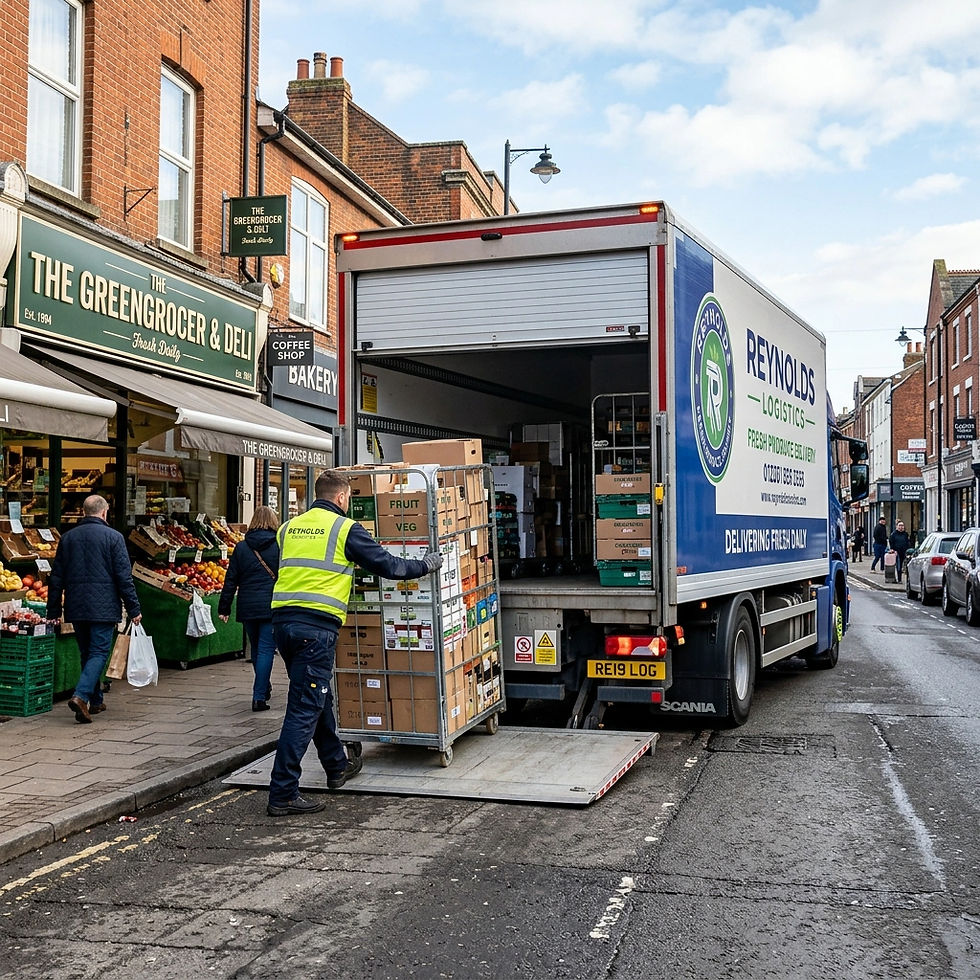
Unfamiliar Sites, Loading Bays, Paperwork, Wrong Turns & When to Stop and Ask
You have found the customer.
Excellent.
Unfortunately, this does not necessarily mean the difficult bit is over.
You may now need to work out:
which entrance takes HGVs;
where goods-in is;
where to book in;
which bay you're supposed to use;
whether you can actually get the vehicle into that bay;
what the site's rules are;
what is being loaded;
whether it is the load you were expecting;
whether the paperwork matches it;
whether a seal needs checking;
whether you need a weighbridge ticket;
and how you're going to get back out again.
Meanwhile, somebody may be enthusiastically pointing towards an entrance and saying:
“Ah yeah. Lorries get in there all the time.”
Welcome to deliveries and collections.
FIRST: YOU ARE ALLOWED TO STOP AND THINK
This is one of the most useful habits a new HGV driver can develop.
When something doesn't look right:
STOP.
Don't make a bad situation worse because people are watching.
Don't rush because there is a car behind you.
Don't continue because the customer is waving you forward.
Don't blindly follow the sat-nav.
Don't assume the planner knows exactly what the entrance looks like.
And don't think:
“Well, I've started now, so I suppose I have to keep going.”
You don't.
Stop somewhere safe.
Secure the vehicle if necessary.
Look.
Think.
Ask.
“EVERYONE ELSE GETS IN HERE”
You will probably hear this at some point.
Closely related phrases include:
“You'll get that in.”
“We get artics in here all the time.”
“There's loads of room.”
“Just swing her around.”
“The other driver did it yesterday.”
And, from the office:
“You'll be grand.”
Maybe you will.
But here's the important bit:
THEY ARE NOT DRIVING YOUR LORRY.
The person telling you that another HGV fits may not know:
its length;
its height;
its wheelbase;
its trailer;
its axle configuration;
its ground clearance;
its turning circle;
how it was loaded;
or what route that driver actually used.
Perhaps the other vehicle was a rigid.
Perhaps it was a shorter trailer.
Perhaps it entered from the opposite direction.
Perhaps the driver knew the site extremely well.
Perhaps the customer is simply wrong.
“IT'LL FIT” IS NOT A MEASUREMENT
If you're unsure about:
height;
width;
length;
turning space;
overhead clearance;
ground clearance;
axle/load limits;
bridge clearance;
gate width;
low branches;
parked vehicles;
or whether you'll actually be able to get back out,
stop and assess it.
Use GOAL — Get Out And Look where safe.
Ask for assistance.
Ask whether there is another HGV entrance.
Ask whether vehicles normally reverse in from the road.
Ask whether somebody can move an obstruction.
Ask another professional driver who knows the site.
But ultimately:
you are driving the vehicle.
DON'T LET AN AUDIENCE DRIVE YOUR LORRY
This deserves saying again.
You will occasionally find yourself manoeuvring with:
cars waiting;
forklifts waiting;
warehouse staff watching;
another driver waiting for the bay;
somebody waving enthusiastically;
and a planner wondering why you haven't booked in yet.
None of them have your view from the cab.
None of them control your steering wheel.
Take the time you need to manoeuvre safely.
If you need another shunt:
take another shunt.
If you need to GOAL:
GOAL.
If you need everyone to wait:
they can wait.
ARRIVING AT AN UNFAMILIAR PREMISES
Ideally, you've already done some homework.
Our Route Planning guide covers this properly, but before arrival it can be worth establishing:
the correct HGV entrance;
approach direction;
site access restrictions;
opening/booking times;
vehicle-size restrictions;
low bridges or weight limits nearby;
whether you need to reverse in;
whether there is turning room;
and who you should report to.
As you approach, slow the whole process down mentally.
Look for:
HGV entrance signs;
goods-in;
security;
gatehouse;
loading areas;
one-way systems;
pedestrian routes;
speed limits;
height restrictions;
weighbridges;
PPE requirements;
and site-specific instructions.
WRONG ENTRANCE
It happens.
You follow the address and discover you've arrived at:
Reception.
Lovely reception.
Beautiful flower beds.
Absolutely nowhere to put a 16.5-metre artic.
Don't panic.
Don't try to make the vehicle fit because you're embarrassed.
Stop safely if possible.
Contact the site.
Explain where you are.
Ask for directions to the HGV entrance.
If necessary, contact your office.
A wrong entrance is usually a minor inconvenience.
Trying to rescue the situation with an unsafe manoeuvre can turn it into something considerably more expensive.
YOU MISSED THE TURN
Also happens.
Especially when:
you're watching traffic;
the entrance is badly marked;
the sat-nav is late;
it's dark;
you're concentrating on road position;
or the entrance simply doesn't look like an HGV entrance.
KEEP GOING SAFELY.
Do not:
slam on the brakes;
reverse on a public road;
swing suddenly across lanes;
mount something;
or attempt a ridiculous manoeuvre to save five minutes.
Find somewhere suitable to recover the route.
The delivery will survive.
YOU'RE LOST
Again:
don't panic.
Find somewhere safe to stop.
Then:
Work out where you actually are.
Check your route.
Contact the customer if appropriate.
Contact the office if necessary.
Start again.
Getting lost is not a professional catastrophe.
Continuing blindly because you don't want to admit you're lost can be.
BOOKING IN
Many sites require drivers to book in before doing anything else.
This may be at:
security;
gatehouse;
reception;
goods-in;
transport office;
warehouse office;
or through an electronic system/app.
You may need:
company name;
vehicle registration;
trailer number;
customer/order/reference number;
delivery/collection number;
load details;
driver's name;
identification;
seal number;
booking time;
or paperwork.
Have what you can ready.
It saves everybody time.
SITE RULES APPLY TO YOU TOO
Every site is different.
You may be required to:
wear hi-vis;
wear safety footwear;
wear a hard hat;
follow a one-way system;
obey a site speed limit;
use designated pedestrian routes;
surrender your keys;
switch the engine off;
disconnect suzies;
apply trailer parking brakes;
use wheel chocks;
remain in the cab;
leave the cab;
wait in a driver's room;
use a particular loading area;
or follow another local procedure.
ASK IF YOU DON'T KNOW.
“I didn't know” isn't much help after an incident.
SITE RULES DO NOT OVERRIDE SAFETY
Equally, if you're instructed to do something that you genuinely believe is unsafe, stop and clarify it.
Site procedures should be designed to manage risk.
If the instruction and the actual situation don't appear to match, ask.
Don't improvise simply because you're afraid of looking inexperienced.
FINDING YOUR BAY
Make sure you have the correct bay.
Sounds obvious.
Still goes wrong.
Check:
bay number;
warehouse/section;
whether you're loading or unloading;
whether you need to wait before approaching;
and whether somebody needs to authorise you onto it.
If you're unsure:
ASK.
WRONG BAY
You've reversed perfectly onto Bay 14.
You are delighted with yourself.
The warehouse operative appears.
“You're meant to be on 41.”
Annoying?
Yes.
A disaster?
No.
Move when instructed and when safe.
Do not let embarrassment make you rush the second reverse.
LOADING-BAY SAFETY
Loading bays are busy workplaces.
You may have:
forklifts;
pedestrians;
other HGVs;
moving trailers;
dock levellers;
loading equipment;
restricted visibility;
noise;
and people concentrating on completely different jobs.
HSA workplace-transport guidance stresses the need to control vehicle movements, reversing and loading/unloading risks around workplaces.
Before positioning:
understand where you're going;
watch pedestrians;
use mirrors/cameras properly;
GOAL if necessary;
follow banksman instructions where provided;
and do not assume people behind you have seen you.
A BANKSMAN HELPS YOU — THEY DON'T REPLACE YOU
A competent banksman or signaller can be enormously useful.
But you remain responsible for controlling the vehicle.
If:
you lose sight of them;
you don't understand the signal;
somebody else starts giving contradictory signals;
or you're not happy with what you're being asked to do,
STOP.
Clarify.
Then continue.
KEYS-CONTROLLED PROCEDURES
Some sites use a key-control system to prevent a vehicle being moved while loading or unloading is taking place.
You may be required to:
park correctly;
apply the parking brake;
switch off;
remove the key;
hand the key to warehouse/security staff;
place it in a lockbox;
or follow another controlled procedure.
This exists for a reason.
A vehicle pulling away from a loading bay while somebody or something is still connected to it can have catastrophic consequences.
Follow the site's system.
Don't bypass it because you're in a hurry.
DO NOT PULL AWAY UNTIL YOU KNOW LOADING/UNLOADING IS COMPLETE
Never assume.
You may need confirmation that:
loading is finished;
people are clear;
dock equipment is clear;
trailer doors are secured;
restraints are complete;
keys have been formally returned;
and you're authorised to leave the bay.
Then conduct whatever checks are necessary before moving.
COLLECTIONS: CHECK WHAT HAS ACTUALLY BEEN LOADED
This is a big one.
You arrived expecting:
10 pallets of widgets.
There are now 14 pallets of something (?) in the trailer.
Don't assume somebody else has checked it.
Depending on the operation and what you can reasonably inspect, check relevant details against your instructions and paperwork.
That may include:
product;
quantity;
pallet count;
weight;
destination;
load position;
condition;
temperature;
dangerous-goods information;
seal;
or other job-specific details.
“THE WAREHOUSE LOADED IT” DOESN'T END THE CONVERSATION
Different responsibilities apply in different operations, and drivers may not always be permitted or physically able to observe loading.
But if something is obviously wrong:
raise it.
If the paperwork says 12 pallets and you can see 16:
ask.
If you were told you're collecting one load and the paperwork describes another:
ask.
If the weight looks wildly different from what you were expecting:
ask.
If you're uncertain:
ask.
CHECK THE LOAD IS SECURE BEFORE YOU LEAVE
Where you have responsibility or opportunity to check load security, do it.
Consider:
movement;
distribution;
restraints;
doors;
curtains;
straps;
chains;
bars;
partitions;
seals;
axle loading;
and anything specific to that load.
Our HGV Smart Ireland Safe Loading & Load Security guide covers this properly.
THE LOAD ISN'T WHAT YOU WERE TOLD
Do not simply leave and hope it sorts itself out.
Contact the appropriate person.
That may be:
warehouse;
customer;
planner;
traffic office;
Transport Manager;
or another responsible person.
Explain the discrepancy.
For example:
“My collection instruction says 18 pallets for Dublin. The paperwork I've been given says 22 pallets and lists a different delivery reference. Can we check this before I leave?”
That's not being awkward.
That's doing your job.
WRONG LOAD
Sometimes the wrong goods genuinely get loaded.
If you identify it before departure, excellent.
You've just saved everybody a considerably larger problem.
If you discover it later:
stop somewhere appropriate and contact the office.
Don't conceal it.
Don't invent a solution.
Don't start rearranging somebody's logistics operation yourself unless you're authorised to do so.
WRONG TRAILER
Yes.
This happens too.
Particularly in yards containing multiple identical trailers.
Before coupling and leaving, check the trailer identity.
Depending on the operation, that may mean checking:
trailer number;
registration where applicable;
load reference;
destination;
seal;
documentation;
and physical trailer.
Coupling beautifully to the wrong trailer is still coupling to the wrong trailer.
If you realise after moving:
STOP AND REPORT IT.
WEIGHT
Know what you're carrying.
Pay attention to:
gross vehicle weight;
axle weights;
trailer limits;
load distribution;
and any weight information supplied.
A vehicle can be within its permitted gross weight and still have an overloaded axle.
We've covered this separately in the HGV Smart Ireland weight and axle-weight guidance.
If the figures don't make sense:
don't guess.
WEIGHBRIDGE TICKETS
If the job requires weighing, retain the relevant ticket/documentation.
Check:
vehicle/trailer details where shown;
gross/tare/net figures;
date/time;
load/product information;
and anything else required by the job.
If a figure appears wrong:
query it before disappearing down the road.
TEMPERATURE-CONTROLLED WORK
For refrigerated or temperature-sensitive loads, you may need to deal with:
required set point;
actual load temperature;
trailer temperature;
temperature records;
pre-cooling requirements;
loading duration;
door openings;
and customer documentation.
Do not assume:
“The fridge is running, therefore everything is fine.”
Know the procedure for the particular load and company.
If temperature is outside the required range, report it.
Don't quietly change a number on paperwork to make the problem disappear.
SEALS
Some loads/trailers/containers may be sealed.
Where seals are used, check what your procedure requires.
This may include:
seal present;
seal intact;
seal number;
number matching paperwork;
recording who applied/removed it;
and reporting discrepancies.
BROKEN OR MISSING SEAL
A broken seal does not automatically mean theft.
But it does require explanation.
Do not simply fit another seal and pretend nothing happened.
Depending on the operation:
stop;
report it;
photograph it if appropriate;
record the seal number;
follow company/customer/security procedures;
and obtain instructions.
This is particularly important for high-value, customs-controlled, secure or sensitive loads.
PAPERWORK: DON'T BE AFRAID OF IT
A new driver can be handed a pile of documents containing boxes, abbreviations and signatures and think:
“I have absolutely no idea what any of this means.”
That's okay.
Ask.
Paperwork becomes much easier once you've seen it a few times.
DELIVERY NOTES
A delivery note generally records the goods being delivered and provides information associated with that delivery.
Check relevant details such as:
customer;
delivery address;
reference/order number;
goods/quantity;
date;
and any special information.
At delivery, the receiving party may sign or otherwise confirm receipt.
POD — PROOF OF DELIVERY
POD simply means:
PROOF OF DELIVERY.
Depending on the company, this may be:
signed paper;
electronic signature;
app confirmation;
photograph;
scanned document;
or another approved system.
Your employer/customer may have specific requirements.
Follow them.
A load being physically delivered is not always the end of the job.
The business may need evidence that it was delivered correctly.
GET THE POD RIGHT
Check whether you need:
signature;
printed name;
date;
time;
company stamp;
quantity confirmation;
comments;
damage notation;
or another form of confirmation.
A beautiful signature that nobody can identify may not be particularly useful six weeks later when the customer disputes receiving the goods.
CMR
For international road freight, you may encounter a CMR consignment note.
CMR relates to the international carriage of goods by road under the CMR Convention.
The document records important information about the consignment and the parties involved.
A new international driver should learn how their company expects CMR documentation to be checked and completed.
Don't treat it as random paperwork.
And don't sign boxes you don't understand merely because somebody points at them.
MANIFESTS
A manifest may list the goods, consignments, stops or cargo being carried.
This is particularly relevant in operations involving:
multiple consignments;
multidrop;
groupage;
ferry movements;
air/sea connections;
or other organised freight movements.
Again:
check that what you're carrying reasonably corresponds with what the documentation says you're carrying.
SIGNING PAPERWORK
Your signature means something.
Before signing, understand what you're being asked to confirm.
Are you confirming:
collection?
delivery?
quantity?
condition?
seal?
temperature?
time?
receipt of paperwork?
something else?
Don't blindly sign because somebody says:
“Just sign there.”
Ask:
“What am I signing for?”
Perfectly reasonable question.
DON'T SIGN SOMETHING YOU KNOW IS FALSE
If paperwork contains information you know is incorrect, raise it.
Don't knowingly sign a false statement just to get out of the yard.
Equally, don't turn every tiny clerical error into an international incident.
Ask for it to be corrected or appropriately noted.
If you're unsure whether you should sign:
CONTACT THE OFFICE.
DAMAGED GOODS
If you see damage:
record and report it.
Ideally before leaving the collection point where possible.
Depending on company procedure:
photograph it;
note it on paperwork;
inform warehouse/customer;
inform your office;
and get appropriate acknowledgement.
What you do not want is to arrive at the delivery point and hear:
“The driver damaged that.”
when the damage was already present at collection and nobody recorded it.
DAMAGE DURING DELIVERY OR COLLECTION
Vehicle damage works the same way.
You clipped something.
Caught a mirror.
Scraped the trailer.
Damaged a mudguard.
Touched a loading bay.
Whatever happened:
REPORT IT.
Do not hide it.
A small incident can usually be dealt with.
A driver concealing an incident creates a second problem — and often a much more serious one.
MAKING A MISTAKE WITHOUT PANICKING
Every experienced driver has made mistakes.
Every single one.
Wrong turn.
Wrong gate.
Wrong bay.
Missed entrance.
Misjudged something.
Forgotten something.
Coupled to something they shouldn't have.
Started manoeuvring and realised it wasn't going to work.
The difference between a small mistake and a serious incident is often what happens next.
THE HGV SMART MISTAKE RULE
STOP → SECURE → THINK → ASK → FIX
STOP
Stop making the situation worse.
SECURE
Make sure the vehicle and surroundings are safe.
THINK
What has actually happened?
ASK
Who can help — site staff, planner, TM, another driver?
FIX
Choose the safest sensible solution.
Notice what's missing?
PANIC.
Panic contributes absolutely nothing useful.
DON'T LET EMBARRASSMENT MAKE THE NEXT DECISION
This matters enormously for new drivers.
You've taken the wrong entrance.
People are watching.
Cars are queuing.
Somebody is waving.
You're embarrassed.
Your brain says:
“JUST GET OUT OF HERE.”
That is precisely when you need to slow down.
Take the shunt.
Get out and look.
Ask somebody to stop traffic if appropriate.
Get a competent banksman.
Ring the customer.
Whatever is required.
Five minutes of embarrassment is considerably cheaper than hitting something.
WHEN SOMEBODY IS WAVING YOU BACK
Never blindly follow a stranger's hand signals.
If you're happy they're acting as a competent banksman/signaller and you understand their signals, fine.
If you're not:
stop.
And if they disappear from your mirror:
STOP.
Do not assume they're still somewhere safe.
“KEEP COMING!”
Possibly the two most terrifying words in haulage when shouted by somebody you cannot see.
If you are not satisfied:
stop.
WHEN TO STOP AND ASK
Stop and ask if you're uncertain about:
the entrance;
vehicle clearance;
bay;
reversing space;
site procedure;
load;
weight;
load security;
trailer;
documentation;
seal;
temperature;
delivery reference;
dangerous goods information;
where you're supposed to go next;
or what somebody is asking you to sign.
There is no prize for confidently doing the wrong thing.
BEFORE LEAVING A COLLECTION
Take a minute.
Check what applies to your job:
☐ Correct trailer☐ Correct load☐ Correct destination☐ Correct quantity/reference where reasonably checkable☐ Load secure☐ Doors/curtains secured☐ Seal fitted/recorded if required☐ Weight acceptable☐ Axle loading considered☐ Temperature correct where applicable☐ Paperwork received☐ Weighbridge ticket received if required☐ Site equipment disconnected/removed☐ Trailer/vehicle safe to move☐ Route/next destination understood
BEFORE LEAVING A DELIVERY
Again, check:
☐ Correct goods delivered☐ Delivery complete☐ POD completed☐ Required signature/name/date/time obtained☐ Any shortages/damage recorded☐ Paperwork retained/returned correctly☐ Electronic POD completed if required☐ Trailer/load secure for onward journey☐ Doors/curtains secured☐ Equipment accounted for☐ Site departure procedure followed☐ Next job understood
IF SOMETHING DOESN'T MATCH
Use this very simple rule:
DON'T GUESS.
You were told 18 pallets.
There are 22.
Ask.
You were told Bay 6.
Security says Bay 19.
Ask.
Your paperwork says Cork.
The labels say Galway.
Definitely ask.
The seal number doesn't match.
Ask.
The weight doesn't make sense.
Ask.
The customer wants you to sign something you don't understand.
Ask.
Your collection is completely different from what the planner described.
Ask.
AND TELL THE OFFICE EARLY
Remember our Dealing with the Office guide.
Don't wait until you've left the site and driven 100 km before mentioning something you noticed at collection.
Give the planner/TM an opportunity to solve the problem while you're still somewhere the problem can actually be solved.
A NEW DRIVER IS NOT EXPECTED TO KNOW EVERY SITE
This is worth finishing on.
Experienced drivers can make unfamiliar sites look effortless.
They know:
which gate;
which lane;
where to swing;
which bay;
where the office is;
which paperwork they want;
where to turn;
and exactly where the awkward drain is that everybody else nearly hits.
You don't.
Yet.
There is no shame in that.
The first time you visit somewhere, it is the first time you've visited somewhere.
Ask.
Look.
Take your time.
Remember what you learned for next time.
That's how experience is built.
FINALLY
Deliveries and collections are not just:
Drive there → unload → drive away.
They're part driving, part communication, part paperwork, part observation and occasionally part solving a puzzle designed by somebody who has apparently never seen an articulated lorry.
You will:
miss turns;
find wrong entrances;
reverse onto wrong bays;
misunderstand instructions;
encounter incorrect paperwork;
find loads that aren't what you expected;
and make mistakes.
That's professional driving.
What matters is what you do next.
Don't panic.
Don't hide mistakes.
Don't let embarrassment make decisions for you.
Don't sign something you don't understand.
Don't take a load you know isn't right without raising it.
Don't blindly believe “everyone else gets in here.”
And whenever you're not sure:
STOP AND ASK.
Nobody ever became a worse professional driver by taking thirty seconds to make sure they were doing the right thing.



Comments