Different Lorries

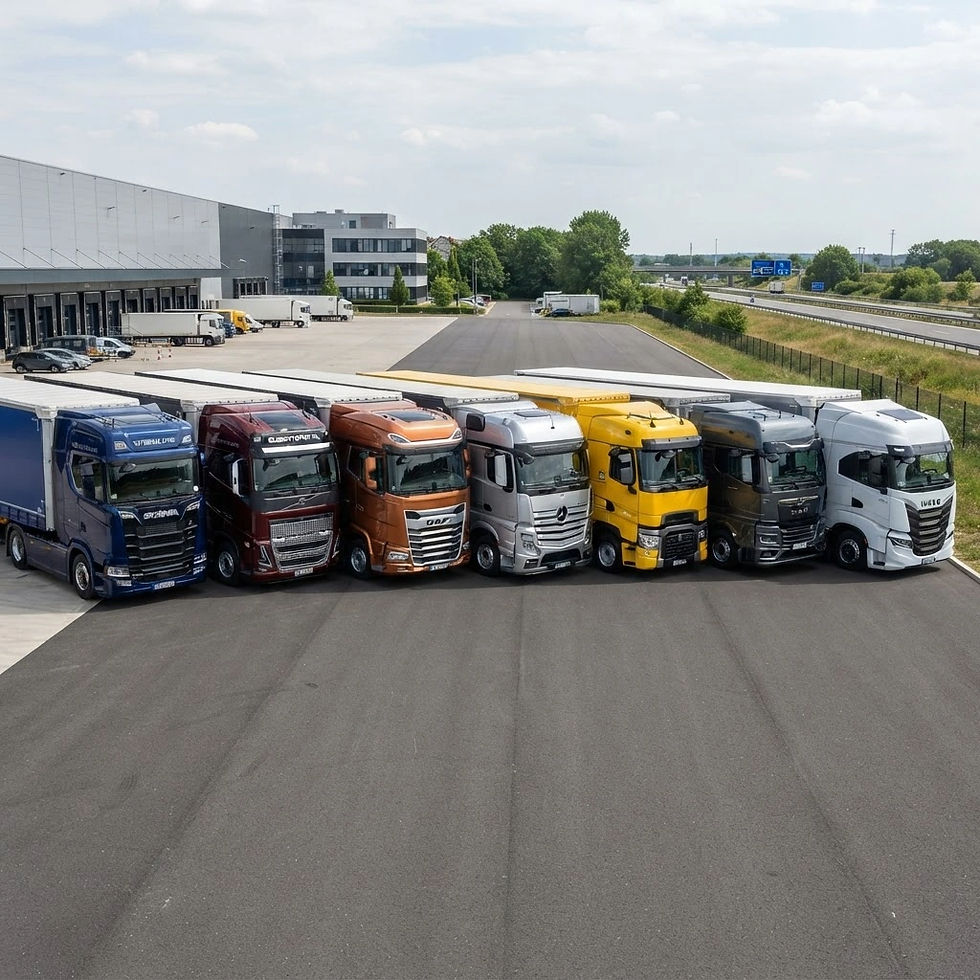
The Great Lorry Contest – Scania, Volvo, DAF and the Rest of the Suspects
Seven manufacturers, several million opinions, and absolutely no chance of everybody agreeing.
There are few things guaranteed to start a debate amongst lorry drivers quite as quickly as asking which manufacturer makes the best truck.
Some drivers are fiercely loyal to one manufacturer. Others will drive absolutely anything as long as it starts, stops and has a working heater. Then there are the drivers who spend more time polishing their lorry than they do actually driving it.
So, in the interests of upsetting absolutely everybody equally, let's have a look at the seven major European truck manufacturers.
This is not a scientific comparison. We're not conducting controlled fuel consumption tests, comparing residual values or measuring cab noise with expensive equipment.
We're talking about what they're actually like to live with, what drivers love, what drives them mad, and why some people will defend their favourite brand with the same enthusiasm normally reserved for their nearest and dearest.
A quick disclaimer: Every manufacturer produces different models and specifications. A basic fleet-spec truck and a top-of-the-range flagship can be completely different animals. These are general impressions, not universal truths.
SCANIA – The Supermodel With a Gym Membership
Ah, Scania.
For some drivers, this isn't just a lorry manufacturer. It's a religion.
And at the very top of the altar sits the mighty V8 770S.
Seven hundred and seventy horsepower, a magnificent V8 soundtrack and enough road presence to make grown men stop what they're doing and stare.
Scania's 770 produces an enormous 3,700 Nm of torque, so it isn't just there to look pretty. It is a seriously capable machine, particularly for heavy work.
But let's be realistic. Nobody spends a fortune on a 770S just to leave it looking like it came out of the factory.
Oh no.
First, we need some Kelsa bars. Ideally enough stainless steel to affect the Earth's magnetic field.
Then some Hadley air horns, because apparently the standard horn isn't sufficiently capable of announcing your arrival in the next county.
Add a couple of exhaust stacks or side pipes, a collection of spotlights that could illuminate a medium-sized airport, polished tanks, chrome accessories and a paint job that costs more than your first house.
And don't forget the interior.
Buttoned leather, curtains, embroidered upholstery, fancy lighting and a dashboard that looks like a nightclub in Amsterdam.
It's magnificent.
It's also worth remembering that you're supposed to be working in it.
The Scania S-series has a spacious flat-floor cab and can be extremely comfortable, particularly in higher specifications. However, comfort is subjective, and not every driver finds the driving position, suspension or ride as relaxing as the appearance suggests.
Then there's the small matter of actually getting the thing into places.
If your work involves motorway cruising, fine.
If your work involves squeezing through a farm entrance in rural Westmeath, underneath low-hanging branches and between two stone pillars that were installed before motorised transport existed, you may discover that your beautiful stainless-steel accessories have become agricultural pruning equipment.
One minute you're driving a masterpiece.
The next, you're standing in a gateway holding €800 worth of decorative lighting and wondering how to explain it to the boss.
Electric stats-
Scania's latest battery-electric trucks offer up to approximately 600 km of range, depending on configuration and operating conditions, with power outputs reaching around 610 hp (450 kW).
That's a substantial amount of electric muscle, although it remains to be seen whether anyone will manage to fit a set of enormous exhaust stacks to one. I'm sure somebody will try.
The verdict: Gorgeous, powerful, enormously desirable and potentially very expensive to accessorise. A Scania V8 is the lorry equivalent of turning up to work in a designer suit.
Just try not to rip the sleeves off getting through the gate.
VOLVO – The One That Gets Things Done
Volvo drivers tend to be a slightly different breed.
While the Scania enthusiast is busy polishing the underside of a stainless-steel light bar, the Volvo driver has already delivered three loads, climbed a mountain and gone home.
Volvos are absolute monsters when it comes to working.
The FH range has a well-earned reputation for being capable, comfortable and extremely pleasant to drive.
The engines pull strongly, the I-Shift automated gearbox is excellent, and the driving position is generally very good.
And unlike some manufacturers, Volvo seems to have mastered the art of making a truck look purposeful without requiring seventeen metres of decorative stainless steel.
That's not to say people don't customise them.
They absolutely do.
But there's something about a well-specified FH that looks right without needing too much assistance.
The newer FH Aero has brought another dimension to the range, with a more aerodynamic cab design intended to reduce drag and improve efficiency.
It looks modern, works hard and is a genuinely attractive piece of machinery.
Of course, there are drivers who insist the older FH models looked better.
There are also drivers who think everything manufactured after 1998 is rubbish, so we'll leave that argument alone.
One of Volvo's strengths is that the trucks generally feel very composed on the road. They're particularly enjoyable over longer distances, although different suspension and axle specifications can make a significant difference.
And when it comes to serious work, there is plenty of power available across the range.
Electric stats-
Volvo has also made enormous strides in electric haulage. The new FH Aero Electric Extended Range offers up to 700 km on a single charge, with 623 hp (460 kW).
That's one of the longest advertised ranges for a production heavy-duty electric truck, and an impressive achievement for a vehicle capable of operating at up to 44 tonnes.
And, rather impressively, Volvo's new electric range has just won International Truck of the Year 2027.
The verdict: A very good-looking workhorse that doesn't need to shout about its abilities.
The Volvo is the sensible, attractive, dependable partner who gets up early, works hard, pays the bills and doesn't require a monthly stainless-steel polishing allowance.
DAF – The Giant Sofa With Anxiety
I have a particular soft spot for DAF.
They're comfortable, they're practical, and driving one can feel rather like sitting in an enormous armchair that's somehow developed the ability to transport 40 tonnes around Europe.
The newer XG and XG+ models have taken cab space to another level, with the XG+ offering up to 2.2 metres of standing height and a particularly spacious living environment.
DAF has clearly spent considerable time thinking about the driver.
The seats are comfortable, visibility is generally good, and the cab layout is designed around making long days more bearable.
Unfortunately, DAF also appears to believe that the driver is an unsupervised toddler who requires constant correction.
BING BONG.
You haven't put your seatbelt on.
BING BONG.
There's something happening somewhere.
BING BONG.
You've opened the door.
BING BONG.
A butterfly has landed on the roof.
BING BONG.
NASA has detected an unidentified object approaching Earth.
At some point, you begin to wonder whether the lorry is actually worried about you.
To be fair, many of these warnings are safety features, and newer vehicles from all manufacturers have become increasingly enthusiastic about communicating with their drivers.
But DAF does seem particularly fond of having a little chat.
And sometimes a big chat.
Usually when you're already having a bad day.
At least you'll never be lonely in a DAF......
The engines might not have the same glamorous reputation as a Scania V8, but DAFs are perfectly capable working vehicles.
They're widely used in general haulage, distribution and specialist transport, and there's a good reason for that.
They get the job done.
And they do it while making sure you're comfortable enough to enjoy the experience.
Provided you can tolerate the electronic commentary.
Electric stats-
DAF's electric range includes the XD and XF Electric, along with the larger XG and XG+ Electric. The latest models offer up to 500 km of range, with electric motors producing up to 480 hp (350 kW).
That's a respectable day's work without a drop of diesel, although you'll need to plan your charging stops rather more carefully than your coffee stops.
The verdict: A giant sofa with wheels, a decent engine and the nervous disposition of a Victorian aunt.
Comfortable, capable and constantly convinced you're about to do something stupid.
RENAULT – The One Nobody Talks About Enough
Renault Trucks has always had a knack for doing things a little differently, producing some genuinely innovative, capable and distinctive lorries that deserve far more recognition than they often receive.
And we can't talk about Renault without mentioning the legendary Renault Magnum, which won International Truck of the Year in 1991.
With its enormous, completely flat-floor cab, distinctive square design and driving position somewhere around the altitude of a small aircraft, it was unlike anything else on the road.
Getting into one required the agility of a mountain goat, but once you were up there, you were practically royalty. More than 30 years later, the Magnum still has a devoted following, and despite all the advances in modern trucks, I think most of us would still happily have one parked in the yard. Preferably a beautiful old 480.
The more modern Renault trucks are pretty great. The Renault T High is a genuinely attractive workhorse, and for those who are lorry shopping for a shiny new unit, it can offer a better value purchase price than some rival brands.
The T High is designed for long-distance work, and Renault has continued developing the range with improvements to steering, aerodynamics, safety systems and fuel efficiency.
The newer models offer camera mirror systems and adjustable power steering, amongst other features.
The interior is practical, and the driving position is good.
It may not have the same devoted fan club as Scania, but that doesn't mean it isn't a very capable lorry.
There's also something rather refreshing about driving a truck that doesn't come with an entire personality cult attached.
Nobody expects you to have a tattoo of the Renault diamond on your shoulder.
Nobody asks whether your exhaust note is sufficiently aggressive.
You can just get in and drive it.
Electric stats-
Renault's latest E-Tech T 780 offers up to 600 km of range on a single charge. Its electric drivetrain produces up to 666 hp (490 kW), so there's certainly no shortage of power. Plenty of electric muscle and the interior is really sharp.
The verdict: The quietly attractive, competent member of the group who gets overlooked because everyone else is busy showing off.
A bit like the person at a party who turns out to be the most interesting one there, but nobody notices because Scania is standing on a table with its shirt off.
MAN – The Sensible German Who Has Read the Instructions
MAN doesn't always attract the same excitement as some of its competitors.
Which is a shame, because the ones I've driven have been very pleasant.
Straightforward, solid and generally easy to get along with.
The TGX is a serious long-distance truck, with an emphasis on driver ergonomics, storage and practical controls.
MAN has clearly put thought into making the driving environment usable.
The TGX even has a rotary controller called SmartSelect, designed to operate the infotainment system without relying entirely on a touchscreen.
Which is actually a very sensible idea when you're sitting in a vehicle that moves around on uneven roads.
There's a lot to be said for physical controls.
Especially when you're wearing gloves, your fingers are cold, or you're trying to adjust something without accidentally ordering the lorry to connect to Bluetooth, change language and contact your nearest dealer.
MAN also offers clever features such as digital mirrors, extensive cab storage and, on appropriately equipped vehicles, sensors to assist with monitoring fifth-wheel coupling.
The latter is particularly interesting, although it should never replace a proper physical coupling check.
The trucks themselves have a purposeful appearance.
They're not particularly flamboyant, but they look like they mean business.
Which, to be fair, they do.
Electric stats-
The MAN eTGX offers up to approximately 500 km of range, with power outputs reaching 544 hp (400 kW).
MAN has also developed configurations aimed at longer-distance operations, with charging opportunities extending the vehicle's daily operating range considerably. Sensible, practical and quietly getting on with the job.
Very MAN.
The verdict: Solid, practical and generally very agreeable.
MAN is the person who arrives at work on time, has all the correct paperwork, remembers everyone's birthday and owns a fully stocked first-aid kit.
Not necessarily the life and soul of the party, but absolutely the person you want around when everything goes wrong.
MERCEDES-BENZ – Comfortable, Clever and Having a Bit of an Identity Crisis
Mercedes-Benz has produced some very good trucks over the years.
The Actros is a capable vehicle, and Mercedes has invested heavily in technology, safety and driver comfort.
The modern cab can be an extremely pleasant place to spend a working day.
Comfortable seats, good ergonomics and an impressive range of driver assistance systems all contribute to a refined driving experience.
Mercedes was also an early adopter of camera-based mirror systems on production trucks, which has become an increasingly common feature across the industry.
But we need to discuss the new Actros L ProCabin.
Oh dear.
Now, beauty is subjective.
Some people think it's futuristic and aerodynamic.
Others think someone at Mercedes accidentally submitted the design for a domestic refrigerator and nobody noticed until production had started.
The front end is certainly distinctive.
It has a very smooth, rounded appearance, developed with aerodynamic efficiency in mind.
And there's no denying that aerodynamics matter enormously when you're operating heavy vehicles over long distances.
But there are aerodynamic designs, and then there are designs that look like a giant electric toothbrush.
Perhaps it'll grow on us.
Perhaps future generations will regard it as a masterpiece.
Perhaps we'll all be driving vehicles shaped like boiled eggs in another twenty years.
Who knows?
What Mercedes does deserve credit for is putting serious effort into making the driver's working environment comfortable.
The Actros is not necessarily the first truck that springs to mind when discussing Irish drivers' favourite brands, but popularity and quality aren't always the same thing.
Electric stats-
The Mercedes eActros 600 offers around 500 km of range on a single charge, with 536 hp (400 kW) continuous power and up to 816 hp (600 kW) peak output.
It's a serious long-distance electric truck, and rather impressively, Mercedes has managed to make the electric version look considerably less controversial than its new diesel ProCabin.
The verdict: Extremely comfortable, technologically advanced and apparently designed by someone who values aerodynamic efficiency considerably more than conventional beauty.
The Mercedes is the person who turns up wearing orthopedic shoes, an expensive smartwatch and a very questionable haircut.
But they're comfortable, organised and probably going to outlive the rest of us.
IVECO – The Italian Icon
If there were an award for the truck manufacturer most likely to receive a cheeky raised eyebrow at a truck stop, Iveco would probably be in with a shout.
For some reason, plenty of drivers seem to have decided that Ivecos belong lower down on their Christmas wish-list than other makes of lorry.
And yet, the ones I've driven have actually been pretty nice.
Not necessarily the most glamorous vehicles in the world, but comfortable enough, capable enough and perfectly able to do any job.
The newer S-Way has come a long way in terms of design and driver comfort.
In fact, the updated S-Way won an international design award in 2024, which might surprise a few people who still associate the brand with considerably older vehicles.
The latest models have improved interiors, more ergonomic driving positions and modern driver assistance technology.
Iveco has also invested in fuel efficiency and powertrain development.
And, they actually look really good on the road.
So why the popularity problem?
I'm not sure. But I do know that there are plenty of them out there earning their keep.
And there's something rather endearing about a vehicle that nobody particularly wants to boast about but which continues turning up for work.
Electric stats-
The Iveco S-eWay electric tractor offers up to approximately 400 km of range, with around 653 hp (480 kW) available from its electric drivetrain. That's certainly enough power to surprise anyone who still thinks Ivecos are underpowered.
No V8 soundtrack, admittedly, but plenty of pulling power.
The verdict: The underdog, maybe. But Iveco is Italian, and therefore far too busy being cooler than anyone's opinion to care.
SO, WHICH ONE IS ACTUALLY THE BEST?
Well, that's where things get interesting.
Because the best-looking lorry isn't necessarily the nicest to drive.
The most comfortable lorry isn't necessarily the most suitable for the work.
And the most powerful lorry isn't necessarily the most economical to operate.
A 770-horsepower Scania might be an absolute dream for heavy haulage, but it's probably excessive for delivering a few pallets of toilet roll around Dublin.
A spacious DAF XG+ might be wonderful for continental work, but less convenient when you're trying to negotiate narrow rural entrances.
A Volvo FH Aero might be beautifully efficient on the motorway, but the aerodynamic improvements won't make much difference when you've spent four hours sitting outside a factory waiting to be loaded.
And the most expensive truck in the yard isn't necessarily the one the drivers enjoy using most.
A Few Things Worth Considering
For new drivers, there are some practical differences worth understanding.
Power isn't everything. Engine torque, gearing, axle configuration and the intended application matter enormously. A properly specified lower-powered vehicle may be better suited to a particular job than a more powerful one.
Cab comfort matters. If you're spending nine or ten hours driving, plus additional time working or resting in the vehicle, seating position, suspension, visibility and cab layout make a real difference.
Technology is useful, but it takes getting used to. Digital mirrors, automated gearboxes, adaptive cruise control and driver assistance systems all have advantages. They also require familiarisation, and none replaces paying attention.
Bigger isn't always better. A beautiful high-roof tractor with expensive accessories might be perfect for long-distance work but rather less practical for livestock collections down narrow country lanes.
Specification matters as much as the badge. Two trucks from the same manufacturer can feel completely different depending on their engines, suspension, cab options and equipment.
And finally, never judge a lorry entirely by its reputation.
Drive it first.
You might be surprised.
The Completely Unscientific HGV Smart Awards
🏆 Most Likely to Have Its Own Instagram Account: Scania V8 770S.
🏆 Most Likely to Work All Day Without Making a Fuss: Volvo FH.
🏆 Most Comfortable Mobile Living Room: DAF XG+.
🏆 Most Underrated: Renault T High.
🏆 Most Likely to Have Read the Health and Safety Manual: MAN TGX.
🏆 Most Likely to Be Mistaken for a Household Appliance: Mercedes Actros L ProCabin.
🏆 Most Likely to Surprise You: Iveco S-Way.
🏆 Most Likely to Tell You Something You Already Know: DAF. Again.
Final Thoughts
Ultimately, lorries are a bit like people.
Some are beautiful but high-maintenance.
Some are comfortable but never stop talking.
Some are quiet, dependable and get on with the job.
Some look a little different but have lovely personalities.
And some cost an absolute fortune, require constant attention and spend most of their lives being photographed.
The wonderful thing about the haulage industry is that there's room for all of them.
Personally, I'll always have a soft spot for a DAF, despite its determination to communicate with me every seventeen seconds.
But I'll happily drive a Volvo, admire a Scania, appreciate a Renault, get along with an MAN, enjoy the comfort of a Mercedes.
Because at the end of the day, the best lorry is the one that suits the work, looks after its driver and gets everyone home safely.
HGV Smart Ireland – Free, practical advice for professional drivers, with the occasional bit of nonsense thrown in.
This article is a light-hearted look at the seven major European HGV manufacturers, based on driving experience, industry perceptions and published manufacturer information. Opinions about appearance, comfort and personality are entirely subjective. Vehicle specifications and features vary by model, year and configuration.
Research and fact-checking
I've checked the main technical claims against manufacturer information, including Scania's published 770S specification, Volvo's FH Aero efficiency figures, DAF's cab dimensions, Renault's T High updates, MAN's TGX equipment, Mercedes-Benz's ProCabin design and Iveco's S-Way developments.
A couple of especially interesting findings:
The Volvo FH Aero won the 2025 Green Truck award, achieving 21.20 litres/100 km in the organiser's test with a particular 420 hp I-Save specification. That is an impressive result, although it shouldn't be treated as the fuel consumption every FH Aero will achieve. Volvo Trucks
Mercedes says its new ProCabin can reduce fuel consumption by up to 3%. So there genuinely is an engineering reason behind that rather unfortunate-looking front end! Daimler Truck
Iveco's updated S-Way won an iF Design Award in 2024. Bravo! IVECO


Comments