DRIVING AN HGV.

Updated: 2 days ago

ROAD POSITION, SPACE & CONDITIONS
Passing your HGV driving test proves that you have reached the required standard to drive the vehicle.
It does not mean that every road, load, vehicle, junction, hill or weather condition will suddenly be easy.
A heavy commercial vehicle behaves very differently from a car.
It is:
longer;
wider;
taller;
heavier;
slower to stop;
slower to accelerate;
more affected by gradients;
more affected by wind;
more difficult to manoeuvre;
and capable of causing enormous damage if something goes wrong.
Good HGV driving isn't about proving how quickly you can get a large vehicle somewhere.
It is about space, observation, anticipation and control.
THINK FURTHER AHEAD
One of the biggest differences between driving a car and driving an HGV is how far ahead you need to think.
In a car, a poor decision can sometimes be corrected quickly.
In an HGV, you may not have that luxury.
You need to continually ask:
What's happening ahead?
What's likely to happen next?
Where are my escape options?
Is traffic closing up?
Is that light likely to change?
Is somebody likely to pull out?
Is that cyclist about to move?
Is the road narrowing?
Will I fit through that gap?
Is my trailer going to follow the same line as my cab?
Can I stop safely if the situation changes?
The further ahead you identify a developing problem, the less dramatic your response needs to be.
Early observation creates time.Time creates options.
LEAVE SPACE
Space is one of your most valuable safety tools.
Leave enough of it:
in front;
beside you;
behind where possible;
around vulnerable road users;
at junctions;
when manoeuvring; and
when stopped in traffic.
If somebody moves into the space you've deliberately left in front of you, don't take it personally.
Create the space again.
FOLLOWING DISTANCE
An HGV requires significantly more distance to stop than a car in many circumstances.
Your stopping distance will be affected by:
speed;
vehicle weight;
load;
road surface;
tyres;
brakes;
weather;
gradient;
driver reaction time; and
the behaviour of the traffic ahead.
Do not drive according to the minimum gap you think you can get away with.
Drive according to the space you would need if something suddenly went wrong.
A useful way to think about following distance is in time rather than metres.
Choose a fixed point that the vehicle ahead passes and count the seconds until you reach it.
In poor conditions, increase that gap substantially.
Remember:
The gap is there for braking, not for decoration.
HGV BRAKING
A loaded HGV contains a huge amount of moving mass.
Even with modern braking systems, physics still applies.
Your vehicle does not stop the instant you press the brake pedal.
Stopping involves:
seeing the hazard;
recognising the hazard;
deciding to brake;
physically applying the brakes; and
the vehicle actually decelerating to a stop.
By the time emergency braking becomes necessary, much of the opportunity to avoid the situation has already disappeared.
That is why anticipation is so important.
BRAKE EARLY AND PROGRESSIVELY
Where conditions allow, smooth progressive braking:
gives following traffic more warning;
reduces load movement;
reduces passenger/animal movement where relevant;
helps maintain vehicle stability;
reduces unnecessary wear; and
gives you more options if circumstances change.
Emergency braking exists for emergencies.
Good observation helps prevent ordinary driving situations becoming emergencies.
YOUR LOAD CHANGES THE VEHICLE
The same lorry can feel very different depending on what it is carrying.
Consider:
overall weight;
weight distribution;
centre of gravity;
liquid movement;
hanging loads;
livestock movement;
machinery;
part loads; and
an empty versus fully loaded trailer.
A heavily loaded vehicle may:
accelerate more slowly;
require more braking distance;
behave differently on hills; and
place different demands on the brakes and driveline.
An empty or lightly loaded vehicle is not automatically easier.
High-sided empty trailers can be particularly vulnerable to wind.
Some loads can move even when correctly secured.
Drive the vehicle you have today, not the one you drove yesterday.
ROAD POSITION
Positioning an HGV requires planning.
You need enough room for:
the cab;
the vehicle body;
the trailer;
the trailer wheels;
rear overhang;
other road users; and
whatever happens as the vehicle turns.
Do not position the vehicle purely according to where the front wheels need to go.
You are responsible for all of it.
TRAILER CUT-IN
When an articulated vehicle turns, the trailer wheels do not follow exactly the same path as the tractor unit.
They take a tighter path through the turn.
This is commonly called cut-in or off-tracking.
The tighter the turn, the more important this becomes.
That means your tractor unit may clear:
a kerb;
bollard;
parked vehicle;
cyclist;
pedestrian;
signpost; or
traffic island
while the trailer does not.
This is why you need to monitor the trailer throughout a turn.
NEVER FORGET THE INSIDE
Particular care is needed around:
cyclists;
motorcyclists;
pedestrians;
junctions;
roundabouts;
street furniture; and
tight entrances.
If somebody moves into the space you need:
stop if necessary.
Do not continue the turn simply because you've started it.
REAR SWING
While the rear wheels cut inward during a turn, the rear of the vehicle or trailer can also swing outward.
This is rear swing.
It can catch:
vehicles;
pedestrians;
cyclists;
walls;
gates;
poles;
street furniture; and
anything else close to the outside of your turn.
The longer the rear overhang, the greater the potential issue.
When you turn one way, remember to think about what the other end of the vehicle is doing.
FRONT SWING
The front of the cab also needs space.
During tight manoeuvres, concentrating entirely on mirrors and trailer position can cause a driver to forget how far the front corner of the cab is moving.
Keep scanning.
Don't become so focused on one danger that you create another.
ROUNDABOUTS
Roundabouts can be one of the clearest examples of why an HGV cannot always follow exactly the same line as a car.
Plan early.
Consider:
which exit you need;
lane markings;
traffic around you;
trailer cut-in;
rear swing;
kerbs and islands;
vulnerable road users;
available road space; and
where other vehicles may try to position themselves.
Sometimes an HGV genuinely needs additional road space to negotiate a roundabout safely.
That does not mean you can simply disregard lane markings or other road users.
Use the space deliberately and lawfully.
Signal clearly.
Observe constantly.
If another vehicle enters the space you need, reassess rather than forcing the manoeuvre.
LEFT AND RIGHT TURNS
Approach tight turns slowly enough that you have time to assess them.
Before turning, consider:
entry position;
available road width;
oncoming traffic;
parked vehicles;
pedestrians;
cyclists;
motorcyclists;
bollards;
signs;
walls;
gates;
trailer cut-in; and
rear swing.
Use your mirrors before, during and after the turn.
A mirror check isn't a single event.
It is a continuous process.
BLIND SPOTS
HGVs can have significant areas around them that are difficult or impossible for the driver to see directly.
Modern mirrors, cameras and detection systems have improved visibility enormously, but they do not make situational awareness optional.
Be particularly conscious of vulnerable road users:
alongside the cab;
close to the passenger side;
immediately in front;
close behind;
beside the trailer; and
around the inside of turns.
Never assume:
“They must know I can't see them.”
They may have absolutely no idea.
Drive accordingly.
CYCLISTS, MOTORCYCLISTS & PEDESTRIANS
Give vulnerable road users space.
Expect unpredictable movement.
A cyclist may:
wobble;
avoid a drain;
move around a parked vehicle;
encounter a pothole;
be affected by wind; or
simply not realise what your vehicle is about to do.
A pedestrian may step into the road.
A motorcyclist may appear alongside you quickly.
If you are uncertain about somebody's position:
wait.
A few seconds costs nothing.
NARROW ROADS
The fact that an HGV can physically fit down a road does not automatically mean it is sensible to proceed without thought.
On narrow roads:
reduce speed;
look far ahead;
identify passing places;
anticipate bends;
watch overhanging trees;
watch walls and roadside structures;
be aware of soft verges;
consider mirrors;
allow for oncoming traffic;
avoid being forced into an unsafe position.
If you meet another large vehicle, communication and patience are often more useful than stubbornness.
Sometimes one vehicle needs to wait.
Sometimes one needs to reverse.
Sometimes the safest decision is not to proceed at all.
SOFT VERGES
Be extremely careful about putting HGV wheels onto soft or unsupported verges.
A verge that comfortably supports a car may not support an HGV.
Risks include:
sinking;
loss of stability;
rollover;
tyre damage;
becoming stuck;
road-edge collapse; and
loss of control.
Do not allow another road user's impatience to pressure you into putting tonnes of vehicle somewhere you believe is unsafe.
PARKED VEHICLES & TIGHT STREETS
Give yourself room.
Watch for:
opening doors;
pedestrians;
children;
vehicles pulling out;
wing mirrors;
projecting loads;
badly parked vehicles; and
narrowing road space.
If the gap is questionable, don't use hope as a measuring device.
Stop and assess it.
HILLS
Weight changes everything on hills.
A heavily loaded HGV will lose speed uphill and gain speed quickly downhill.
Plan before the gradient.
CLIMBING
Before a significant climb:
assess the gradient;
consider your weight;
choose an appropriate gear strategy;
maintain safe momentum where possible;
expect speed to reduce; and
consider traffic behind you.
Don't wait until the engine is struggling badly before thinking about gear selection.
Modern automated transmissions will manage much of this themselves, but the driver still needs to understand what the vehicle is doing.
DESCENDING — CONTROL YOUR SPEED BEFORE THE HILL CONTROLS IT
A long descent requires planning.
Do not simply begin descending and then decide how you are going to control the vehicle.
Before the descent:
assess the gradient;
reduce speed if necessary;
select an appropriate gear or driving mode;
understand the retarder/engine-braking system;
allow sufficient space ahead; and
avoid allowing the vehicle to gather excessive speed.
Supplementary braking systems such as engine brakes and retarders can help control speed and reduce reliance on the service brakes.
BRAKE FADE & OVERHEATING
Repeated or prolonged heavy use of service brakes can generate substantial heat.
Overheated brakes can lose effectiveness.
This is one reason why proper speed management and appropriate use of supplementary braking systems are so important on long or steep descents.
Never descend faster than you can safely control.
DON'T COAST
Do not coast downhill in Neutral or with the driveline unnecessarily disengaged.
You reduce your control of the vehicle and lose useful engine/driveline braking.
Stay in control.
HIGH WINDS
Wind can have a major effect on HGVs.
Particular caution is required with:
empty trailers;
lightly loaded trailers;
high-sided vehicles;
double-deck trailers;
curtain-siders;
box bodies; and
exposed routes.
Danger can increase on:
bridges;
exposed motorways;
open countryside;
coastal roads;
mountain routes; and
when emerging from sheltered areas.
SUDDEN CROSSWINDS
A vehicle may feel relatively stable while protected by:
trees;
buildings;
cuttings; or
another large vehicle.
When that protection disappears, a strong crosswind can suddenly hit the full side of the vehicle.
Be prepared.
Reduce speed where appropriate.
Keep both hands available for proper control.
Avoid abrupt steering.
And remember:
An empty trailer can sometimes be more vulnerable to wind than a loaded one.
OVERTAKING & BEING OVERTAKEN
Large vehicles can affect one another aerodynamically.
When another HGV passes you — or you pass one — you may feel changes in air pressure or crosswind exposure.
Maintain control and avoid unnecessary steering corrections.
Only overtake when:
permitted;
genuinely necessary;
you have sufficient speed differential;
visibility is adequate; and
the manoeuvre can be completed safely.
An HGV travelling 1 km/h faster than another HGV does not automatically make an overtake a good idea.
RAIN
Rain affects:
visibility;
tyre grip;
stopping distance;
road spray;
mirrors;
camera visibility; and
the ability of other drivers to see you.
Reduce speed as conditions require and increase following distance.
Use lights appropriately.
Keep windscreens, mirrors and cameras clear.
STANDING WATER & AQUAPLANING
Standing water can cause loss of tyre contact with the road surface.
Avoid large areas of standing water where possible.
If you cannot safely avoid water:
reduce speed beforehand;
avoid sudden steering;
avoid harsh braking; and
maintain controlled inputs.
Do not drive into water when you cannot establish its depth or whether the road underneath is intact.
FLOODING
An HGV's size does not make it immune to flood water.
Flood water can:
hide road damage;
hide obstacles;
affect brakes;
damage electrical systems;
enter engines;
move vehicles;
conceal missing road edges; and
leave you stranded.
Do not assume:
“I'm in a truck — I'll get through.”
If you cannot determine that it is safe:
do not enter.
Find another route or wait.
FOG
Fog can reduce visibility extremely quickly.
Reduce speed according to how far you can actually see.
Increase following distance.
Use appropriate lights.
Do not follow another vehicle closely simply because its rear lights provide something to look at.
You need enough visible road to stop within the distance available to you.
Fog lights should be used appropriately and switched off again when they are no longer required.
SNOW & ICE
Snow and ice affect:
braking;
steering;
acceleration;
traction;
trailer stability; and
gradient capability.
Everything needs to become smoother:
steering;
braking;
acceleration;
gear changes; and
speed changes.
Increase your distance enormously.
Avoid unnecessary sudden inputs.
Plan hills before reaching them.
Remember that bridges and exposed sections can freeze before surrounding roads.
Shaded areas may remain icy after other roads have thawed.
BLACK ICE
Black ice may be difficult or impossible to see.
Warning signs can include:
very low temperatures;
unusually light steering;
lack of tyre noise;
other vehicles behaving unexpectedly;
frost nearby; or
road sections known to freeze easily.
If grip is compromised, sudden braking or steering can make the situation worse.
Reduce speed before known high-risk areas whenever possible.
USING RETARDERS IN LOW-GRIP CONDITIONS
Powerful supplementary braking systems can affect driven-wheel grip.
On snow, ice or other slippery surfaces, inappropriate or aggressive use may contribute to loss of traction or stability.
Follow the vehicle manufacturer's guidance.
If you are unfamiliar with the system fitted to the vehicle, find out how it behaves before you need it on a slippery descent.
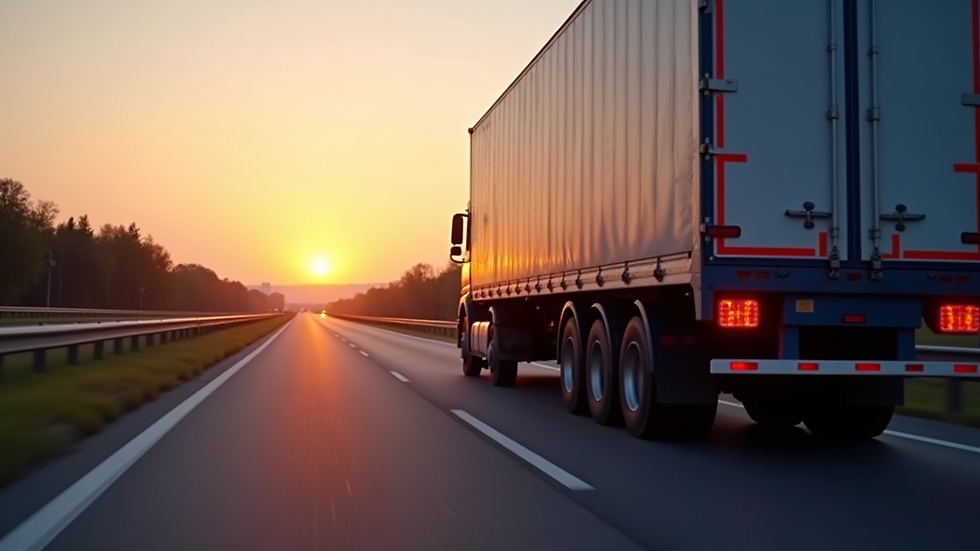
SUN GLARE
Bad weather isn't the only visibility problem.
Low sun can suddenly leave you almost unable to see.
Keep:
windscreen clean;
washer fluid topped up;
sunglasses available if suitable; and
sun visor accessible.
If visibility becomes dangerously poor, reduce speed appropriately.
If you cannot see sufficiently to continue safely, stop somewhere safe.
NIGHT DRIVING
At night:
visibility is reduced;
hazards can appear later;
pedestrians and cyclists may be harder to see;
fatigue may become more significant;
judging distance can become harder; and
poorly lit roads require greater anticipation.
Make sure lights, windscreen, mirrors and cameras are clean.
Don't drive faster than the distance you can see to be clear.
BAD WEATHER DOES NOT CANCEL DRIVERS' HOURS
Poor weather, congestion and delays do not simply remove the legal requirements surrounding driving time, breaks and rest.
Plan conservatively when severe conditions are forecast.
Allow extra time.
Do not build a schedule that only works if the roads are perfect.
If unforeseen circumstances create a genuine exceptional situation, specific legal provisions may sometimes be relevant — but they are not a general permission to plan beyond the rules.
WHEN IS IT TOO BAD TO CONTINUE?
This is one of the most important decisions a professional driver can make.
There is no prize for continuing when conditions have become unsafe.
You should continually assess:
visibility;
wind;
road grip;
flooding;
snow;
ice;
vehicle stability;
traffic behaviour;
warnings/restrictions;
your route;
your load; and
your own ability to control the vehicle safely.
There may come a point where the correct professional decision is:
STOP.
“BUT THE OFFICE SAYS KEEP GOING.”
The person on the phone is not sitting in your driver's seat.
They may not be able to see:
the snow;
standing water;
wind movement;
fog;
road surface;
blocked road;
traffic conditions; or
how the vehicle is behaving.
Tell them clearly what the conditions are.
Explain why you believe continuing would be unsafe.
Find somewhere safe to stop where possible.
Keep the operator updated.
But do not allow pressure over:
a delivery slot;
collection time;
customer;
ferry;
schedule; or
somebody else's impatience
to make you drive in conditions you genuinely believe are unsafe.
You are the person controlling the vehicle.
IF YOU NEED TO STOP — STOP SOMEWHERE SAFE
“Stop driving” does not mean stop wherever you happen to be.
If conditions allow, look for:
proper HGV parking;
a service area;
designated rest area;
suitable truck stop;
safe yard;
appropriate off-road location; or
another lawful place where the vehicle can be safely parked.
Avoid creating a new hazard while trying to escape another one.
DON'T LET TRAFFIC BEHIND YOU DRIVE YOUR LORRY
At some point, somebody behind you will believe you should be:
going faster;
turning faster;
pulling out sooner;
squeezing through a smaller gap; or
taking a chance you don't want to take.
Let them believe it.
Their impatience is not part of your risk assessment.
Do not allow a car sitting six feet from your rear bumper to make decisions about the safe speed of a 40-tonne vehicle.
SMOOTH IS PROFESSIONAL
Smooth driving isn't just about comfort.
It benefits:
vehicle stability;
load stability;
fuel consumption;
tyres;
brakes;
driveline components;
livestock welfare;
fragile goods; and
other road users.
Look ahead.
Plan early.
Accelerate progressively.
Brake progressively.
Steer smoothly.
Create space.
IF YOU GET IT WRONG — STOP AND RESET
Every driver occasionally misjudges something.
You may:
take the wrong position;
realise a turn is tighter than expected;
find yourself approaching an unsuitable road;
misjudge available space; or
simply become uncomfortable with what is developing.
Do not compound one mistake with another because you're embarrassed.
Stop safely.
Reassess.
Ask for help if necessary.
Get out and look where it is safe and appropriate to do so.
Take another route.
Allow somebody to guide you if suitable.
Resetting a manoeuvre is considerably more professional than continuing with one you know is going wrong.
A SIMPLE HGV DRIVING MINDSET
As you drive, keep asking yourself:
SPACE
Do I have enough room?
TIME
Am I giving myself enough time to react?
HEIGHT
Is there sufficient clearance?
WIDTH
Will the whole vehicle fit?
LENGTH
What is my trailer doing?
WEIGHT
How is my load affecting the vehicle?
SURFACE
How much grip do I actually have?
WEATHER
How is it affecting this particular vehicle?
ESCAPE
What will I do if the situation changes?
DRIVER
Am I still comfortable that this is safe?
REMEMBER
You don't have to prove anything by driving quickly.
You don't have to squeeze through because a car could.
You don't have to continue a turn because you've started it.
You don't have to drive onto a verge because somebody else wants past.
You don't have to continue in weather you believe is unsafe.
You don't have to let the vehicle behind set your speed.
And you don't have to pretend you're comfortable when you're not.
Professional HGV driving is not about being fearless.
It is about recognising risk early enough that you rarely need to be.
Give yourself space.Give yourself time.Look further ahead.And never let somebody else's impatience drive your lorry.


Comments