FERRY MODE.

Updated: 2 days ago
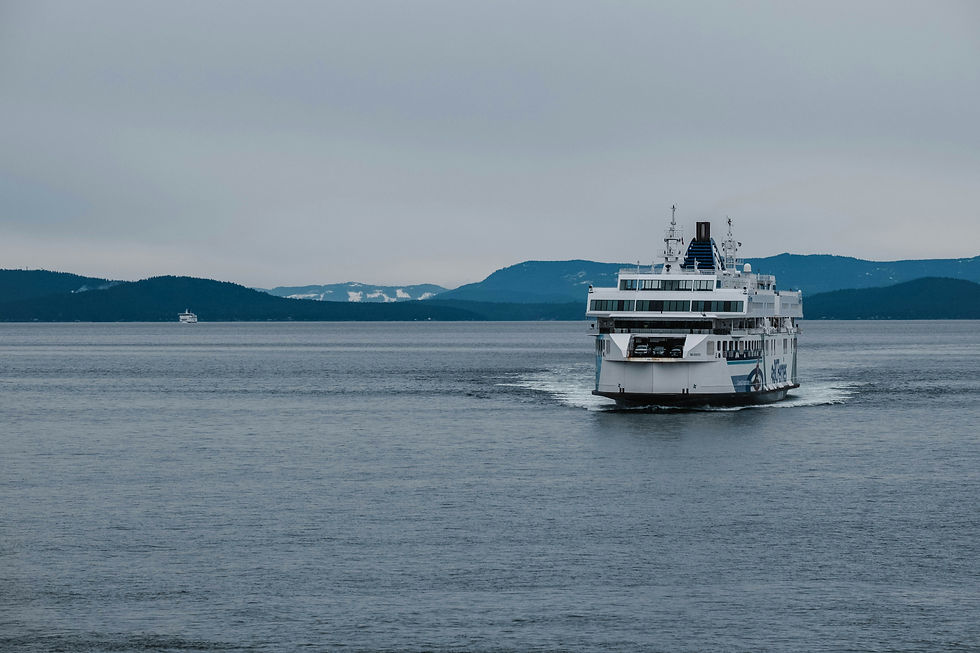
What It Actually Does, When to Press It & How Not to Ruin a Perfectly Good Rest.
Ferry mode.
Possibly one of the most frequently misunderstood bits of tachograph use.
It gets explained as:
“Just put it on the boat symbol.”
Excellent.
When?
Before you move?
After you move?
While you're sitting in the boarding lane?
When you're actually on the boat?
Do you leave it on for the whole crossing?
What happens when the tachograph changes itself to Drive?
Can you interrupt nine hours?
Do you need 11 hours including the driving, or 11 hours plus the driving?
Can you take some rest before the ferry and finish it afterwards?
What about weekly rest?
And why, if this is supposedly so simple, do so many perfectly sensible drivers get it wrong?
Let's sort it out properly.
FIRST: WHAT IS FERRY MODE ACTUALLY FOR?
Normally, a qualifying rest needs to be rest.
You aren't supposed to interrupt it by driving the lorry around.
Obviously, ferries create a problem.
You might:
park in the boarding lane → start resting → drive onto the ferry → park → rest during the crossing → drive off → park again → continue resting.
Without a specific provision in the law, those little bits of driving would break the rest period.
So Article 9 of Regulation (EC) 561/2006 provides a ferry/train derogation.
In normal human language:
Under specific conditions, you are allowed to interrupt certain qualifying rest periods to move the vehicle on and off a ferry or train without destroying the whole qualifying rest.
That's what we're doing.
FERRY MODE DOES NOT TURN DRIVING INTO REST
This is probably the most important thing to understand.
Pressing Ferry/Train does not make driving count as rest.
It does not stop the tachograph recording Drive.
It does not pause time.
It does not give you an hour of free driving.
It does not suspend drivers' hours legislation.
The ferry/train entry helps identify that the activity forms part of a permitted Article 9 interruption.
The law gives you the derogation.
The little boat symbol doesn't.
THE GOLDEN NUMBERS
For the ferry/train derogation:
MAXIMUM TWO INTERRUPTIONS
and
MAXIMUM ONE HOUR IN TOTAL.
Not one hour each.
One hour combined.
Typically:
Interruption 1 = boarding
Interruption 2 = disembarking
If boarding takes 20 minutes and disembarking takes 15 minutes:
35 minutes total interruption.
Fine.
If the two interruptions total 65 minutes:
you've exceeded the one-hour limit.
Article 9 expressly sets the limit at no more than two interruptions by other activities totalling no more than one hour.
AND YOU STILL NEED THE ACTUAL REST
This is where another misunderstanding creeps in.
Suppose you're taking an 11-hour regular daily rest.
You don't need:
10 hours rest + 1 hour driving = 11 hours.
Absolutely not.
You need the qualifying:
11 HOURS OF REST
with the permitted interruptions sitting in addition to that rest.
So imagine:
REST → DRIVE ON → REST → DRIVE OFF → REST
The bits marked REST can contribute to your qualifying rest.
The bits where you're moving the lorry are interruptions.
They don't.
SIMPLE EXAMPLE
You rest for:
3 hours before boarding
Then spend:
15 minutes boarding
Then rest:
7 hours on the ferry
Then spend:
15 minutes disembarking
Then park and rest for:
1 further hour
Your actual rest is:
3 + 7 + 1 = 11 hours.
Your interruptions total:
15 + 15 = 30 minutes.
That's the basic principle.
THE 24-HOUR RULE HASN'T DISAPPEARED
If you're using ferry mode as part of a regular daily rest, you still need to satisfy the normal requirement to have taken the required daily rest within each relevant 24-hour period.
Ferry mode doesn't give you an extension to your working day simply because there's a boat involved.
So if you're planning to finish the required rest ashore:
LEAVE ENOUGH TIME.
Don't construct a plan where absolutely everything needs to happen to the minute.
Ferries have an unfortunate habit of not consulting your tachograph before deciding when to board and discharge.
WHICH DAILY REST CAN I INTERRUPT?
For the Article 9 daily-rest derogation, we're talking about:
REGULAR DAILY REST.
A regular daily rest is normally at least:
11 HOURS.
A regular daily rest can alternatively be split:
3 HOURS + 9 HOURS
in that order, giving at least 12 hours in total.
The regulation defines a reduced daily rest separately as at least nine but less than 11 hours.
CAN I INTERRUPT A REDUCED 9-HOUR DAILY REST?
NO.
This catches people.
The ferry derogation does not turn an interrupted nine-hour reduced daily rest into a valid ferry rest.
Article 9 specifies a regular daily rest, not a reduced daily rest.
So for daily rest:
11-hour regular daily rest — YES
qualifying split regular daily rest — potentially YES
9-hour reduced daily rest — NO
NOW LET'S ACTUALLY USE THE TACHOGRAPH
This is where we move from legislation into:
What the hell do I actually press?
Let's use the most common scenario.
You're taking a qualifying regular daily rest around a ferry crossing.
STEP 1 — YOU'RE IN THE BOARDING LANE
You're parked.
You've finished working.
You're genuinely resting.
SELECT REST.
The bed symbol.
Your qualifying rest can begin here.
You do not need to wait until you're physically on the ferry before beginning the rest.
This is extremely useful on shorter crossings because the time spent genuinely resting before and after the vessel can form part of the overall qualifying rest.
STEP 2 — THE FERRY STARTS BOARDING
Eventually somebody appears and starts waving lorries forward.
Before you begin the movement associated with boarding:
SELECT FERRY / TRAIN.
You're identifying the start of the interruption associated with the ferry movement.
Then move when instructed.
STEP 3 — THE LORRY MOVES
Once you drive, the tachograph records:
DRIVE.
That's correct.
Don't panic because the bed symbol has disappeared.
You're driving.
It should record driving.
Remember:
Ferry mode does not disguise driving as rest.
The drive onto the vessel is part of your permitted interruption.
STEP 4 — YOU'RE PARKED ON THE FERRY
Once you're properly parked and finished with whatever work is required:
SELECT REST AGAIN.
Bed symbol.
You are now continuing your qualifying rest.
This step matters.
Do not assume that pressing Ferry/Train before boarding somehow leaves the tachograph recording rest for the entire crossing.
Check the mode.
IMPORTANT: CHECK THE BED SYMBOL
This is one of the best habits you can develop with a tachograph generally.
Don't think:
“I'm sure I put it on rest.”
Look.
Is the bed actually displayed?
Yes?
Lovely.
Move on with your life.
No?
Correct it.
THE TACHOGRAPH ASKS WHETHER YOU WANT TO END YOUR SHIFT
Some Smart Tachograph units may prompt you after the ignition is switched off.
You're on the ferry.
Your qualifying rest is still continuing.
DON'T AUTOMATICALLY END THE SHIFT.
Read the question before pressing buttons.
If your intention is to continue the same rest period through the crossing, don't accidentally close things off merely because the tachograph offered you an option.
Tachographs are very good at asking questions.
Drivers are occasionally very good at pressing YES before reading them.
Slow down.
STEP 5 — ENJOY YOUR REST
Assuming the legal conditions are satisfied, you're now resting during the crossing.
And there's another important condition:
YOU NEED ACCESS TO PROPER SLEEPING FACILITIES.
For a regular daily rest or reduced weekly rest using Article 9, the driver must have access to a:
sleeper cabin;
bunk; or
couchette.
For the special regular-weekly-rest provision, the driver must have access to a sleeper cabin on the ferry/train.
We'll come back to weekly rest shortly.
STEP 6 — YOU'RE ABOUT TO DISEMBARK
If your qualifying rest is already complete, that's one situation.
If you're going to continue the qualifying rest ashore, that's another.
Let's deal with the second one first.
You're going to drive off the ferry, find your suitable parking place and continue resting.
Immediately before the movement associated with disembarking:
SELECT FERRY / TRAIN AGAIN.
This identifies the second interruption.
Then drive off.
The tachograph records Drive while you're moving.
Correct.
STEP 7 — PARK ASHORE
Once you reach the appropriate place where you're going to continue your rest:
park safely.
Then:
SELECT REST AGAIN.
Now you're continuing the same qualifying rest period after the second permitted interruption.
THE WHOLE THING LOOKS LIKE THIS
REST
boarding lane
↓
FERRY / TRAIN
immediately before boarding movement
↓
DRIVE
onto vessel
↓
REST
on vessel
↓
FERRY / TRAIN
immediately before disembarking movement if continuing the qualifying rest
↓
DRIVE
off vessel / to the appropriate stopping place
↓
REST
ashore
↓
COMPLETE THE REQUIRED REST
That's the basic sequence.
WHAT IF MY REST IS ALREADY COMPLETE WHEN THE FERRY ARRIVES?
Different situation.
Suppose you've already accumulated the required qualifying rest by the time you're due to drive off.
You're no longer trying to preserve an unfinished rest after disembarkation.
Once your rest is complete and you resume work, record the activity you're actually undertaking.
That may become:
Drive
or
Other Work
depending on what you're actually doing.
Don't continue treating the day as though an unfinished rest needs preserving when the qualifying rest has already been completed.
DON'T ACTIVATE FERRY/TRAIN FAR TOO EARLY
This is particularly important with newer tachographs.
Don't sit in the boarding lane and press Ferry/Train half an hour before anybody has asked you to move.
You are resting.
Record rest.
The ferry/train entry is associated with the permitted interruption.
Use it at the appropriate point around the movement rather than treating it as a general:
“I am somewhere near a boat”
button.
SMART TACHOGRAPH 2
Smart Tachograph 2 adds more automated location information and ferry/train functionality to the record.
But this is important:
THE TACHOGRAPH DOES NOT UNDERSTAND YOUR LEGAL INTENTION.
It knows things like:
vehicle movement;
GNSS position;
recorded activities;
entries you make.
It doesn't sit there thinking:
“Ah yes, driver is taking an Article 9 regular daily rest and intends to finish another 2 hours 17 minutes after Rosslare."
You still need to make the correct entries.
Technology helps create the record.
The driver still needs to understand the rule.
VDO AND STONERIDGE
The location of Ferry/Train in the menus differs between tachograph manufacturers and versions.
On VDO/Continental units, Ferry/Train is generally accessed through the relevant vehicle/menu-entry functions.
Stoneridge units use their own menu structure.
The important lesson isn't memorising one sequence of button presses for one machine.
It's:
KNOW HOW TO FIND FERRY/TRAIN ON THE UNIT YOU ARE ACTUALLY DRIVING.
If you've changed lorries, check before boarding starts.
SMART 1, SMART 2 AND OLDER DIGITAL TACHOGRAPHS
The displays and functionality differ.
Don't assume that because you know exactly how to use ferry mode on one VDO unit, every other tachograph will behave identically.
The underlying legal requirement doesn't change because the buttons look different.
When unfamiliar:
learn the controls while stationary;
use the manufacturer's guidance where necessary;
ask somebody competent;
and don't experiment while the boarding marshal is waving frantically at you.
WHAT ABOUT COUNTRY ENTRIES?
This has changed as tachographs have become smarter.
Regulation 165/2014 requires country information to be recorded at the beginning and end of the daily working period and contains specific provisions around border crossings.
For older equipment requiring manual border entry, where the border crossing takes place on a ferry or train, the country entered is recorded at the port or station of arrival.
Smart Tachograph 2 can automatically record border crossings.
So again:
KNOW WHAT TACHOGRAPH YOU ARE USING.
Don't blindly apply instructions for an older unit to a newer one.
NOW THE BIT THAT REALLY GETS TAUGHT WRONG:
WEEKLY REST
The ferry/train derogation isn't limited to regular daily rest under current EU law.
Article 9 was expanded.
The current rule also permits interruption of:
REDUCED WEEKLY REST.
A reduced weekly rest is at least:
24 HOURS
subject, of course, to the wider weekly-rest rules and compensation requirements.
The same basic ferry conditions apply:
maximum two interruptions
maximum one hour combined
and access to the required sleeping accommodation.
The RSA's current Smart Tachograph 2 guidance expressly confirms this newer provision.
WHAT ABOUT A REGULAR 45-HOUR WEEKLY REST?
This is where the rule becomes stricter.
A regular weekly rest may also use the Article 9 ferry/train derogation, but only where the ferry/train journey meets the additional conditions.
Under the current consolidated EU Regulation:
the ferry/train journey must be scheduled for more than 8 hours; and
the driver must have access to a sleeper cabin on the ferry or train.
So:
45-hour regular weekly rest + short ferry crossing?
NO.
45-hour regular weekly rest + qualifying long ferry crossing meeting the Article 9 conditions?
YES.
ONE SMALL WORDING TRAP: “8 HOURS”
The actual current consolidated EU legislation says:
scheduled for more than 8 hours.
You may find summaries using slightly different wording.
For HGV Smart Ireland, we are using the legislation:
MORE THAN 8 HOURS.
REGULAR WEEKLY REST AND THE CAB
There's another important rule here.
A regular weekly rest of 45 hours or more cannot simply be taken in the vehicle.
Article 8 requires regular weekly rest, and weekly rest over 45 hours taken as compensation, to be taken in suitable gender-friendly accommodation with adequate sleeping and sanitary facilities rather than in the vehicle.
So don't confuse:
access to a sleeper cabin during a qualifying ferry journey
with:
permission to spend your entire regular weekly rest living in the lorry.
They're different rules.
QUICK TABLE: WHAT CAN FERRY MODE INTERRUPT?
Rest | Article 9 ferry interruption? |
Regular daily rest — 11 hours | YES |
Split regular daily rest — qualifying 3 + 9 arrangement | YES, subject to the rules |
Reduced daily rest — 9 hours | NO |
Reduced weekly rest — minimum 24 hours | YES |
Regular weekly rest — minimum 45 hours | YES, but only with the additional 8-hour+ scheduled journey and sleeper-cabin conditions |
And in every case where the derogation applies:
NO MORE THAN TWO INTERRUPTIONS.
NO MORE THAN ONE HOUR TOTAL.
FERRY MODE IS NOT JUST FOR OVERNIGHT FERRIES
Another misconception.
The crossing itself doesn't necessarily have to provide your entire daily rest.
You may build the qualifying rest around the ferry journey.
For example:
rest before boarding
rest on the vessel
rest after disembarking
can form the qualifying rest where all Article 9 conditions and normal rest requirements are satisfied.
That's one of the reasons understanding the rule matters so much on Irish ferry operations.
BUT A SHORT CROSSING CAN MAKE THE TIMING TIGHT
Suppose you're trying to use:
rest in the port;
a relatively short crossing;
then rest ashore.
Fine in principle where the conditions are met.
But remember:
the boarding and disembarking activities don't count towards the required rest.
And the daily-rest deadline is still sitting there.
So calculate properly.
EXAMPLE: A LEGAL DAILY FERRY REST
Let's make this easy.
You begin regular daily rest at:
18:00
You rest in the port.
At:
21:00
you're called to board.
You've already accumulated:
3 hours rest.
You activate Ferry/Train and spend:
15 minutes
moving onto the ferry.
You park and return to Rest.
You then get:
6 hours 30 minutes rest
on the vessel.
At the destination you activate Ferry/Train again and spend:
15 minutes
disembarking and reaching the appropriate parking location.
You park and select Rest again.
You still need:
1 hour 30 minutes
of actual rest to reach your 11 hours.
So you take it.
Your qualifying rest comprises:
3h + 6h30 + 1h30 = 11 hours.
Your interruptions comprise:
15m + 15m = 30 minutes.
The interruptions did not become rest.
That's ferry mode.
EXAMPLE: THE CLASSIC WRONG VERSION
Driver starts rest.
Drives onto ferry.
Then remembers:
“Oh shit, ferry mode.”
Presses Ferry/Train.
Rests.
Drives off.
Then thinks:
“I'm finished with the ferry now.”
and never makes the appropriate second ferry/train entry while trying to continue the rest.
The activity record may now fail to clearly identify the intended Article 9 interruptions.
That can produce exactly the sort of record that later causes questions during analysis or enforcement.
ANOTHER CLASSIC:
FORGETTING TO RETURN TO REST
You board.
Park.
Turn off the engine.
Go to your cabin.
Sleep beautifully.
The tachograph isn't recording Rest because you didn't check the mode.
Your body may have had an excellent rest.
Your tachograph record may tell a considerably less relaxing story.
CHECK THE BED.
“BUT THE TACHOGRAPH AUTOMATICALLY CHANGES MODES”
Exactly.
That's why you check.
When the vehicle moves, a digital tachograph records driving automatically.
After movement stops, what happens next can depend on the unit's configuration and activity selection.
Never assume.
Look at the display.
MOVING AROUND ON THE FERRY
Remember your limit:
TWO INTERRUPTIONS.
If you've used one to board and one to disembark, that's your two.
If somebody decides halfway through that you need to move the vehicle again, you may now have a problem with the qualifying rest you're trying to preserve.
Don't think:
“It's only two minutes.”
The issue isn't merely the duration.
It's also the number of interruptions.
If you're relying on Article 9 for the rest, additional vehicle movement can destroy the intended qualifying rest.
AND THE TOTAL INTERRUPTION STILL CANNOT EXCEED ONE HOUR
Boarding:
35 minutes
Disembarking:
30 minutes
Total:
65 minutes.
That's more than one hour.
It doesn't qualify merely because both individual movements were less than an hour.
Add them together.
WHAT COUNTS AS THE INTERRUPTION?
Article 9 describes interruption by other activities, not merely driving.
So don't assume the one-hour allowance concerns only the minutes showing crossed hammers/steering wheel.
The permitted interruption is the period during which the qualifying rest has been interrupted by other activity.
This is another reason not to start Ferry/Train unnecessarily early or spend ages doing work between rest periods.
FERRY MODE DOESN'T FIX BAD PLANNING
This needs saying.
If you haven't left enough time to obtain the required rest:
pressing Ferry/Train won't rescue it.
If you've interrupted the rest three times:
pressing Ferry/Train won't rescue it.
If the interruptions total more than one hour:
pressing Ferry/Train won't rescue it.
If you're trying to interrupt a reduced nine-hour daily rest:
pressing Ferry/Train won't rescue it.
If you're trying to interrupt a regular weekly rest on a short crossing:
pressing Ferry/Train won't rescue it.
THE SYMBOL RECORDS THE SITUATION.
IT DOES NOT CREATE LEGALITY.
THE FIVE BIG FERRY-MODE MISTAKES
1. PRESSING FERRY/TRAIN AFTER YOU'VE ALREADY STARTED MOVING
Make the relevant ferry/train entry at the appropriate point before the ferry-related movement.
2. FORGETTING TO GO BACK TO REST ON THE DECK
Once parked and genuinely resting:
BED SYMBOL.
Check it.
3. USING MORE THAN TWO INTERRUPTIONS
Maximum:
TWO.
4. GOING OVER ONE HOUR TOTAL
Maximum combined interruption:
ONE HOUR.
5. TRYING TO USE IT WITH THE WRONG TYPE OF REST
Nine-hour reduced daily rest?
NO.
Regular 45-hour weekly rest on a short ferry crossing?
NO.
Understand what rest you're actually trying to take before you start pressing buttons.
ONE MORE: ENDING THE DAY WITHOUT THINKING
read the prompt.
Don't automatically say yes because you're going to bed.
Your legal rest and the tachograph's start/end-location records need to accurately reflect what actually happened.
PRINT THE RECORD IF SOMETHING GOES WRONG
If you make an incorrect selection, forget an entry, have an unusual movement or otherwise end up with a record that doesn't accurately explain what happened:
don't just pretend it didn't happen.
Where appropriate:
make the necessary manual record/printout;
write the explanation;
add the required identifying details/signature;
retain it with your records;
and tell your operator/TM where necessary.
A contemporaneous explanation is considerably more useful than trying to remember what happened weeks later.
DON'T INVENT A FERRY MOVEMENT
Equally:
never use Ferry/Train to disguise ordinary movement or try to manufacture a compliant rest.
Tachographs record far more information than just the activity symbol.
Modern units also record location and other data.
Create an accurate record of what actually happened.
WHY SMART 2 MAKES UNDERSTANDING THIS MORE IMPORTANT — NOT LESS
Smart Tachograph 2 automatically records more information, including location-related data and border crossings.
That doesn't remove the driver's responsibility.
If anything, it makes:
“That's what I've always done”
an increasingly poor compliance strategy.
The RSA specifically notes the expanded ferry-rule provisions alongside Smart Tachograph 2 requirements.
IF YOU'RE USING AN UNFAMILIAR TACHOGRAPH
Before the ferry:
☐ Find Ferry/Train in the menu☐ Know how to select Rest☐ Know how to check the current activity☐ Know how to make the required location entries☐ Make sure there's printer paper☐ Ask if you genuinely don't know
Do this while parked.
Not while the ramp marshal is developing a personal relationship with the horn.
BEFORE PLANNING A FERRY REST, ASK:
WHAT REST AM I TAKING?
Regular daily?
Reduced weekly?
Regular weekly?
DOES ARTICLE 9 APPLY TO THAT REST?
Don't assume.
HOW MANY INTERRUPTIONS WILL THERE BE?
Maximum two.
HOW LONG WILL THEY TAKE?
Maximum one hour combined.
DO I HAVE THE REQUIRED SLEEPING FACILITY?
It matters.
IF IT'S REGULAR WEEKLY REST, IS THE SCHEDULED CROSSING MORE THAN 8 HOURS?
If not, the regular-weekly ferry derogation doesn't apply.
WILL I STILL COMPLETE THE REQUIRED REST IN TIME?
Ferry mode hasn't abolished the rest deadlines.
THE 30-SECOND FERRY MODE GUIDE
For the ordinary regular-daily-rest scenario:
AT THE PORT
Park → REST
CALLED TO BOARD
Immediately before relevant movement → FERRY/TRAIN
DRIVE ON
Tachograph → DRIVE
PARK ON DECK
Select → REST
BEFORE DISEMBARKING, IF CONTINUING THE REST ASHORE
Select → FERRY/TRAIN
DRIVE OFF
Tachograph → DRIVE
PARK ASHORE
Select → REST
THEN
Complete the required qualifying rest.
And throughout:
maximum two interruptions
maximum one hour combined.
FINALLY
Ferry mode becomes much easier once you stop thinking of it as a mysterious tachograph function.
The important thing isn't the boat symbol.
The important thing is the rest.
You are taking a qualifying rest period.
The law allows that particular rest, under particular conditions, to be interrupted so you can accompany your vehicle through the ferry or train movement.
The tachograph needs to record what actually happened.
That's it.
So remember:
FERRY MODE DOES NOT CREATE THE REST.
IT DOES NOT TURN DRIVING INTO REST.
IT DOES NOT GIVE YOU AN EXTRA HOUR.
IT DOES NOT ALLOW UNLIMITED MOVEMENT.
It helps record the permitted interruptions to a qualifying rest.
Know which rest you're taking.
Start it early enough.
Use Ferry/Train at the right time.
Go back to Rest when you've parked.
Use no more than two interruptions.
Keep them within one hour combined.
And check the bloody bed symbol before you go to sleep.
Because finding out the following morning that you had a lovely night's rest but your tachograph apparently didn't is a particularly irritating way to start the day.



Comments