Tachograph Infringements.

Updated: 2 days ago
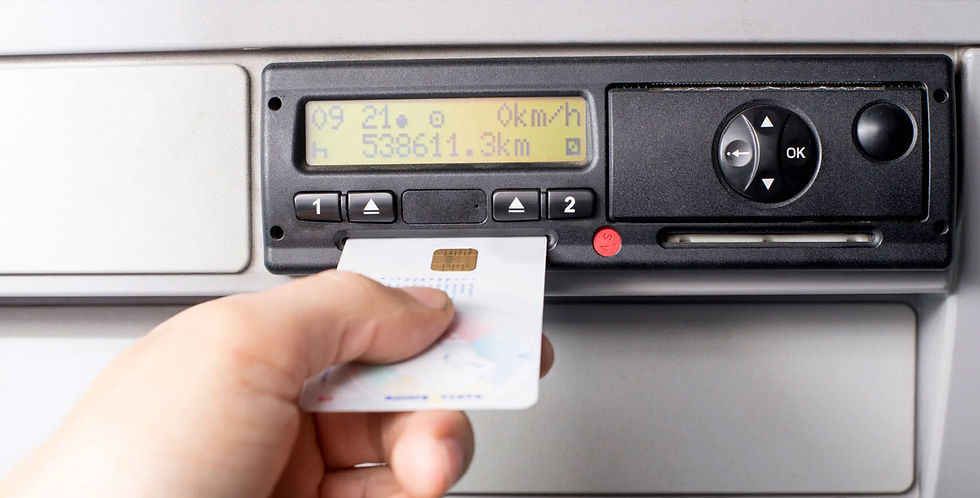
Roadside Checks & Driver Card Problems.
Mistakes happen.
You select the wrong mode. You forget a manual entry. You realise after starting work that something has not been recorded correctly. A driver card stops working. You lose it. Or you are stopped at the roadside and suddenly have to explain several weeks of tachograph records to an enforcement officer.
The most important thing is not to panic and never attempt to hide or falsify a record.
A genuine mistake that has been properly recorded and explained is very different from deliberately creating a false record.
1. What is a tachograph infringement?
A tachograph infringement is a breach of the rules governing drivers' hours, rest, breaks, tachograph use or record keeping.
Common examples include:
exceeding daily driving time
exceeding weekly or fortnightly driving limits
insufficient daily or weekly rest
insufficient break
incorrect use of tachograph modes
failing to make required manual entries
failing to enter required information
failing to use a driver card when required
missing records
incorrect or incomplete records
improper withdrawal or use of a driver card
using somebody else's driver card
allowing somebody else to use your card
deliberately falsifying or manipulating tachograph records
Not every infringement has the same seriousness.
An accidental missing manual entry is clearly not the same thing as deliberately driving on somebody else's card or manipulating a tachograph.
However, apparently minor errors can become important if they happen repeatedly.
2. What happens when an infringement is detected?
Your employer/operator should regularly download and analyse driver-card and vehicle-unit data.
If an infringement appears, it should not simply be ignored.
The driver should be given an opportunity to understand:
What happened?Why did it happen?Was it a genuine mistake?Was the rule misunderstood?Does the driver need further training?What can be done to prevent it happening again?
A good compliance system is not about catching drivers out.
It is about identifying problems before they become patterns.
Repeated infringements can indicate that something needs attention — whether that is driver knowledge, scheduling, route planning, unrealistic work demands or simply poor tachograph habits.
Operators also have responsibilities. They must ensure drivers are properly trained and instructed in tachograph use, regularly check that tachographs are being used correctly and must not encourage drivers, directly or indirectly, to misuse them.
3. Can tachograph infringements result in enforcement action?
Yes.
Drivers' hours and tachograph rules are legally enforceable.
Depending upon the circumstances and seriousness of the breach, enforcement action can include warnings, requests for further information, direction notices, prohibition from continuing until a breach is rectified, further investigation and prosecution.
Both drivers and operators can face consequences.
Some infringements are regarded considerably more seriously than others. Deliberate misuse, falsification or manipulation is particularly serious.
Never alter, destroy, conceal or falsify tachograph evidence in an attempt to make an infringement disappear.
A genuine infringement with an honest explanation is one thing.
Turning it into a falsification issue is something else entirely.
4. Roadside tachograph checks
In Ireland, RSA Transport Officers and other authorised enforcement officers can carry out roadside checks.
During a tachograph inspection an officer may examine or download information from:
your driver card
the vehicle unit
tachograph printouts
analogue charts, where applicable
manual records
other relevant supporting documentation.
Modern tachographs also contain significant amounts of vehicle and activity information.
The best approach to a roadside inspection is simple:
Be cooperative. Be honest. Produce what is requested. Don't invent an explanation for something you don't understand.
If an officer asks about something in your records and you genuinely do not know what caused it, say so.
5. How much tachograph history must I be able to produce?
This changed on 31 December 2024.
Drivers must now be able to produce the required records covering:
the current day + the previous 56 days.
Depending on the driver's work, this can include:
the driver card
manual records
tachograph printouts
analogue charts for relevant periods
other records required under the tachograph/drivers' hours legislation.
This is one reason why printouts should not simply be thrown into the passenger footwell and forgotten about.
If a printout forms part of your required tachograph record, look after it.
6. Missing records
Your working day needs to make sense.
If you remove your card and later reinsert it, the tachograph may ask you to account for the period since the card was last withdrawn.
This is what the manual-entry function is for.
For example, the missing period might contain:
rest
other work
availability
breaks.
Do not automatically enter the entire missing period as rest simply because that is the quickest way through the manual-entry screen.
The record should reflect what you actually did.
7. I've made a mistake on the tachograph. What do I do?
First:
Don't panic.
And don't try to make the evidence disappear.
Depending upon the mistake, make an appropriate contemporaneous record explaining what happened.
A tachograph printout can be extremely useful.
Print the relevant record and clearly write an explanation on it.
Include enough information to identify you and the circumstances, and sign it.
For example:
Incorrect mode selected 08:10–08:35. Period was OTHER WORK while loading. Selected BREAK in error.
NameDriver/card numberSignatureDate
Keep the printout as part of the relevant records and provide it to your employer in accordance with the company's procedures.
The point is to create an honest contemporaneous explanation — not to rewrite history.
8. Driving without a driver card
This is an area where drivers need to be particularly careful.
Your driver card should normally be inserted from the point at which you take over the vehicle and begin activities such as loading, unloading or driving.
You cannot simply choose to drive without your card because:
you left it at home
inserting it is inconvenient
you don't want particular driving recorded
you have reached a driving limit
somebody else has the vehicle
you are only moving the vehicle "a short distance".
The special provisions allowing cardless driving apply where the card is:
LOST, STOLEN, DAMAGED or MALFUNCTIONING.
There are specific procedures that must then be followed.
9. My driver card is lost — what do I do?
If your card is lost, the loss must be formally reported to the relevant competent authorities.
You must apply for a replacement within 7 calendar days.
In Ireland, replacement driver cards are dealt with by the Road Safety Authority (RSA).
Do not wait 15 days before applying.
The 15 days relates to how long you may, in the specified circumstances, continue driving without the card — NOT how long you have to apply for the replacement.
The replacement application deadline is 7 calendar days.
10. My driver card has been stolen
A stolen driver card must be formally declared to the competent authorities in the country where the theft occurred.
You must also apply for a replacement card within 7 calendar days.
Keep evidence of the report and replacement application.
If your card disappears while you are abroad, do not simply wait until you return home before dealing with it.
11. My driver card is damaged or malfunctioning
If the card is damaged or malfunctioning, it must be returned to the competent authority when applying for its replacement.
Before treating a card as faulty, the RSA recommends checking that the problem really is the card rather than the vehicle unit.
For example:
carefully clean the chip
try the card again
try it in another vehicle unit if possible
check whether the VU itself is displaying a card error.
If the card genuinely is damaged or malfunctioning, apply for the replacement within 7 calendar days.
12. How do I apply for a replacement card in Ireland?
The RSA provides replacement applications for lost, stolen, damaged or faulty tachograph cards.
Applications can be made through the RSA driver-card service, including online applications where applicable.
If the card is damaged or faulty, it must be returned to the RSA with the replacement application.
The replacement card will normally retain the expiry date of the card it replaces.
EU rules require the competent authority to provide the replacement within 8 working days after receiving the detailed replacement request.
Keep evidence that you have made the application.
13. How long can I drive while waiting for the replacement card?
This is the important bit.
Where your driver card has been:
lost, stolen, damaged or has malfunctioned
and you have followed the required replacement procedure, you may continue driving without the card for a maximum of:
15 CALENDAR DAYS
There is a limited exception allowing a longer period where this is necessary for the vehicle to return to the premises where it is based, provided the driver can prove that it was impossible to produce or use the driver card during that period.
That is not a general extension of the 15-day allowance.
So don't read:
"15 days, or longer if necessary"
as meaning:
"I can just keep driving until the new card arrives."
You cannot.
14. Does the 15-day rule apply if I simply forgot my card?
No.
Forgetting your driver card is not the same as the card being lost, stolen, damaged or malfunctioning.
The legislation does not provide a general 15-day allowance for a driver who has simply left a functioning card somewhere else.
Treat your driver card like your driving licence or your keys.
Before leaving:
Phone. Wallet. Keys. Driver card.
15. What records must I make while driving without my card?
If you are lawfully driving without your card because it has been lost, stolen, damaged or has malfunctioned, you must create records manually using tachograph printouts.
You need records at the START and END of the journey.
AT THE START
Before driving, make a printout from the vehicle unit showing the vehicle details.
On that printout, record the required information that the tachograph cannot record against your driver card.
This includes information identifying you, such as:
your name
your driver-card number OR driving-licence number
your signature
and any relevant periods of:
other work
availability
break/rest.
AT THE END
At the end of the journey, make another printout showing the periods recorded by the tachograph.
Add any periods of:
other work
availability
break/rest
that have not otherwise been recorded.
Again include your identification details and sign the printout.
The printouts become your tachograph record for that period.
16. How do I actually make the printout?
Exact menu wording varies between tachograph manufacturers and models, but generally you will:
Ensure there is tachograph printer paper in the unit.
Enter the tachograph menu.
Select the PRINT function.
Select the appropriate vehicle/VU daily activity printout.
Select the relevant date where requested.
Print the record.
Write the required driver identification and any missing activity information on the printout.
Sign it.
At the end of the journey/day, repeat the process and ensure any activity not automatically captured is added.
Important: Different tachograph models have different menu structures. If you drive a particular vehicle regularly, learn where its print function is before you actually need it.
And always carry spare tachograph printer rolls.
A roadside inspection is a particularly bad moment to discover that the printer contains three centimetres of paper.
17. What should I write on a cardless-driving printout?
As a practical minimum, make sure the record clearly identifies:
WHO YOU ARE
Name. Driver card number or driving licence number. Signature.
WHAT ACTIVITY OCCURRED
Driving — recorded automatically by the VU.
Other work — add where necessary.
Availability — add where necessary.
Break/rest — add where necessary
WHY THERE IS NO DRIVER CARD
Although the legislation specifies the identification and activity information that must be entered, as good practice it is sensible to clearly note the reason you are operating without the card, for example:
Driver card lost — replacement applied for 12/03/2027.
or
Driver card malfunction — replacement application submitted to RSA 12/03/2027.
Keep supporting evidence of the replacement application/report with you where practicable.
18. How long do I keep the printouts with me?
For roadside-control purposes, the driver must be able to produce required manual records and printouts covering:
the current day and previous 56 days.
So do not hand over your only records and then continue driving with no evidence of the period.
The operator also has record-retention obligations. Tachograph records and relevant Article 35 printouts must generally be retained by the undertaking for at least one year.
Records being relied upon for working-time purposes may need to be retained for longer under the applicable working-time rules and company record-keeping system.
Follow your employer's procedure for submitting originals/copies while ensuring that the records you are legally required to produce remain available to you.
19. What if my card starts working again?
If a supposedly malfunctioning card begins functioning again, tell your employer/Transport Manager and make sure your records remain complete.
Remember that a damaged or genuinely malfunctioning card for which replacement is required must be dealt with through the proper replacement process.
Do not create two competing sets of records or attempt to insert information that does not accurately reflect what happened.
20. What if the tachograph itself breaks?
A faulty tachograph and a faulty driver card are two different problems.
If the tachograph breaks or operates incorrectly, the transport undertaking must arrange repair by an approved fitter/workshop as soon as circumstances permit.
Where the vehicle cannot return to the undertaking's premises within one week from the breakdown or discovery of the fault, the repair must be carried out en route.
While the tachograph is unable to record activities correctly, the driver must create the required manual records.
Do not simply continue for days with a malfunctioning tachograph and assume the vehicle-unit fault excuses the absence of records.
21. Can I use somebody else's driver card?
NO.
NEVER.
A driver card is personal to the driver to whom it was issued.
Do not:
drive using another driver's card
lend your card to another driver
allow somebody else to use yours
use somebody else's card because yours is missing
swap cards to extend driving time.
This is entirely different from making a genuine mistake in a manual entry.
Deliberate misuse of driver cards and tachograph manipulation are serious infringements.
22. What should I carry if I'm temporarily driving without my card?
If you are legitimately driving without a card while awaiting replacement, it is sensible to keep together:
your start-of-journey printouts
your end-of-journey printouts
the required records covering the previous 56 days
evidence of the replacement application
evidence of the theft/loss report where relevant
the damaged/malfunctioning card where appropriate and where it has not already been returned as part of the replacement process
any other documentation explaining the situation.
Think about the roadside officer who knows absolutely nothing about what happened.
Your records should allow that person to understand the situation.
23. Roadside checks — don't make a small problem bigger
If an enforcement officer identifies something unusual:
Don't panic.Don't lie.Don't invent an elaborate explanation.Don't alter a record.Don't blame the tachograph for everything.
Explain honestly what happened.
If you made a mistake, say you made a mistake.
If you don't know what caused something, say you don't know.
If you have a printout explaining an error, produce it.
If your employer has already identified an infringement and provided retraining or corrective action, keep appropriate records of that process.
Professional drivers are human.
The objective is not to produce an imaginary career containing no mistakes whatsoever.
The objective is to use the tachograph correctly, comply with the rules, maintain accurate records and deal properly and honestly with mistakes when they occur.
QUICK REFERENCE — LOST/STOLEN/DAMAGED/
FAULTY DRIVER CARD
CARD LOST Report it formally + apply for replacement within 7 calendar days.
CARD STOLEN Report the theft to the competent authorities where it happened + apply for replacement within 7 calendar days.
CARD DAMAGED/MALFUNCTIONING Confirm the problem is the card where possible, return the faulty/damaged card as required + apply for replacement within 7 calendar days.
WAITING FOR REPLACEMENT You may drive without the card for a maximum of 15 calendar days, subject to the legal conditions.
MORE THAN 15 DAYS? Only where necessary for the vehicle to return to its base and you can prove why producing/using the card was impossible.
DRIVING WITHOUT THE CARD Make the required start AND end printouts, add identification and missing activities and sign them.
ROADSIDE RECORDS Be able to produce the required records for the current day + previous 56 days.
FORGOT YOUR CARD? That is not what the 15-day exemption is for.
SOMEONE ELSE'S CARD? Never.
Important
This guide is intended as a practical educational resource for professional drivers. It does not replace formal Driver CPC training, company procedures, RSA guidance, EU legislation or professional/legal advice.
Rules can change. Drivers and operators remain responsible for ensuring that they are working to the legislation currently in force.



Comments